
GLIMS Journal of Management Review and Transformation

Nisha Rani1
1Department of Management Studies, Central University of Haryana, Mahendergarh, Haryana, India

This article is distributed under the terms of the Creative Commons Attribution-NonCommercial 4.0 License (https://creativecommons.org/licenses/by-nc/4.0/) which permits non-commercial use, reproduction and distribution of the work without further permission provided the original work is attributed as specified on the SAGE and Open Access page (https://us.sagepub.com/en-us/nam/open-access-at-sage).
Although leadership is cited repeatedly as one of the most significant factors affecting start-up survival through their initial years, the nature of leadership practice by start-up founders and senior executives in the early years of a start-up, typically when resources are scarce, is often scattered throughout the entrepreneurship literature. This study aims to fill the gap by systematically identifying the leadership styles studied in the start-up context, and empirically determining which of the studied styles are most common and suitable for the Indian start-up context. A two-stage design was adopted. First, a comprehensive review of literature drawn from Scopus, Web of Science, and Google Scholar was conducted using combinations of the search terms (‘leadership style’ OR ‘leadership behaviour’ OR ‘style of leadership’) AND (‘start-up’ OR ‘startup’ OR ‘new venture’ OR ‘entrepreneurship’ OR ‘early-stage firm’ OR ‘early-stage firm’), yielding 31 distinct leadership styles reported in prior start-up research. Second, a two-round Delphi study was carried out with a panel of 20 experts, comprising founders, co-founders, senior managers, human resource professionals and academicians/consultants specialising in leadership and entrepreneurship, who rated each style on prevalence, relevance, and confidence using a five-point scale. Consensus was measured by standard deviation and interquartile range, using pre-defined thresholds. Members of the Delphi panel were able to converge around five leadership styles which they perceived to be most reflective of Indian start-ups. These styles included entrepreneurial, transformational, transactional, laissez-faire and authentic leadership. The above-mentioned styles indicate Indian start-up leadership may not be encapsulated under a particular leadership theory, but rather a group of styles that balance and integrate leadership themes and characteristics such as opportunity-seeking, vision-setting, structure, autonomy, and integrity. The study provides a comprehensive taxonomy of start-up leadership styles and an empirically valid shortlist of leadership styles for the Indian context, which can have implications for start-up founders, investors and human resource practitioners in designing leadership development interventions for start-up ventures.
Leadership styles, start-ups, Delphi method, entrepreneurial leadership, transformational leadership, India
Introduction
Start-ups are seen as innovation and growth accelerators, as well as job creators, as a result of technological developments, globalisation and, more recently, the facilitation of entrepreneurial ecosystems. Start-ups are emerging businesses that are trying to make their fortune by growing fast and disrupting business models all around the world, introducing new business models (Bala Subrahmanya, 2022). The attention of scholars on start-ups has grown significantly in the last two decades, and their role in economic development, sustainability and strategic innovation has been studied in the context of the global and regional environment, including India (Bala Subrahmanya, 2022; Lee et al., 2025).
The Department for Promotion of Industry and Internal Trade (DPIIT, 2019) defines a ‘Startup’ in India as an entity that, within 10 years of incorporation or registration as a private limited company, partnership firm, or limited liability partnership, has not exceeded an annual turnover of ₹100 crores in any financial year, and is working towards innovation, development, or improvement of products, processes, or services, or possesses a scalable business model with high potential for employment and wealth creation—provided it was not formed by splitting or reconstructing an existing business.
India’s start-up ecosystem has undergone remarkable growth, emerging as a global hub for entrepreneurship. Industry reports from NASSCOM and Zinnov describe rising investor and stakeholder interest, both domestic and international (Bhagavatula et al., 2019; Jalote & Natarajan, 2019; NASSCOM, 2017; Tandon et al., 2020). The launch of the Start-up India-Stand Up India initiative by Prime Minister Narendra Modi on August 15, 2015 marked a turning point in institutional support for entrepreneurship; within a year, India ranked third globally behind the US and UK, with over $5 billion invested and three to four new start-ups launched daily (Inc42, 2016). More recently, the State of Indian Startup Ecosystem Report 2024 records over $150 billion invested between 2014 and mid-2024, with enterprise tech, fintech, and e-commerce accounting for 52% of total funding, and Bengaluru, Delhi NCR, and Mumbai together capturing 89% of investment. The report also highlights the growing prominence of semiconductors and artificial intelligence, projected to reach $17 billion and $150 billion in market value, respectively, by 2030 (Inc42, 2024). By May 2025, India hosted over 159,000 recognised start-ups across more than 760 districts—the third-largest start-up ecosystem globally after the United States and China—with roughly 90,000 DPIIT-approved businesses added between late 2021 and mid-2023, and an estimated 112 unicorns emerging over the same period, taking the cumulative unicorn value beyond $340 billion (Kankariya et al., 2021; Wikipedia.org, 2025).
Leadership is central to start-up success. Zaech and Baldegger (2017) argue that founders must pay closer attention to their leadership style, given that the ability to envision and execute a venture’s ideas depends heavily on leadership qualities (McCarthy et al., 2023). The Oxford Dictionary defines leadership as ‘the action of leading a group of people or an organisation’, and leadership style as ‘the traits, behavioural tendencies, and characteristic methods of a person in a leadership position’. Existing literature has largely focused on the general significance of leadership in start-up ventures, and has very little insight into the process of how leadership is formed and developed in new ventures. Considering the unique socio-economic and cultural milieu of Indian entrepreneurship, the study of leadership in Indian start-ups can go beyond the conclusions drawn from the global studies. This study addresses this gap by analysing the leadership styles prevalent among founders and senior executives in Indian start-ups, with the following research questions:
RQ1: What leadership styles have been studied in the previous start-up literature?
RQ2: What are the most prevalent leadership styles found in Indian start-ups?
RQ3: What leadership styles are found to be most relevant to the success or effectiveness of Indian start-ups?
Literature Review
Start-ups operate in dynamic, uncertain environments where leadership directly shapes team performance, innovation, and organisational survival. Unlike established firms, start-up leaders often assume multiple roles, shaping culture while responding swiftly to change. Despite this, many entrepreneurs underestimate leadership’s role as a catalyst for venture success; Zaech and Baldegger (2017) accordingly call for founders to give leadership behaviour greater attention. The following subsections provide the grouping that follows established behavioural taxonomies of leadership: task-oriented, relations-oriented and change-oriented (Derue et al., 2011; Yukl, 2012), as well as participative, passive, contingency, and context-bound styles.
Visionary/Inspirational (Change-oriented)
These styles operate on the basis of setting a future direction and motivating followers to go beyond their self-interest. Transformational leadership is the prototype (Bass, 1985; Burns, 1978). Visionary leadership is characterised by vision creation and communication (Westley & Mintzberg, 1989). Entrepreneurial leadership is a blend of vision and opportunity enactment and resource mobilisation (Gupta et al., 2004). Strategic leadership is about establishing long-term direction (Ireland & Hitt, 1999). Although the name is ‘authoritative’, Goleman (2000) characterised this style as mobilising people toward a vision; thus, it fits in this category. Millennial Transformational is considered a version of transformational leadership for the millennial generation. These styles are elaborated as follows:
Transformational Leadership
Transformational leadership empowers, influences, and inspires followers to enhance performance by shifting their attitudes, beliefs, and values, extending beyond routine operations to foster shared vision, innovation, and personal growth (Bass, 1990; Burns, 1978). Evidence on its effects, however, is mixed. Founder-CEOs’ transformational leadership shapes managers’ innovative behaviour, an effect mediated by the firm’s innovative climate (Kang et al., 2015), though this relationship does not hold among Canadian SMEs (Gross & Cabanda, 2019). By articulating vision, transformational leaders build trust, optimism, and team spirit, thereby improving the likelihood of start-up success (Joshi & Achuthan, 2018; Zaech & Baldegger, 2017), a finding replicated among Brazilian start-ups (Chammas & Hernandez, 2019) and technopreneurial start-ups, where it is identified as the most recommended strategic leadership style (Mbakara & Sasaka, 2017). Transformational leadership scores correlate positively with CEOs’ hope, optimism, and resilience, and this relationship fully mediates the link between leaders’ psychological attributes and firm performance—an association stronger in start-ups than in established organisations (Peterson et al., 2009). It also interacts favourably with organisational improvisation to enhance start-ups’ innovation performance, an effect strengthened under VUCA conditions (Xiong & Yang, 2024), and is strongly linked to fintech start-up growth in Zambia by fostering self-reliance and persistence among employees (Choongo et al., 2023). Conversely, it shows no significant association with revenue growth among Bangalore start-ups (Prasad & Jahan, 2021a).
Early-stage start-ups are particularly receptive to transformational leadership, as it channels employees’ passion and ideals into greater contribution (Zhao & Ren, 2022). It positively influences employees’ recommendations to supervisors and peers, mediated by organisational psychological ownership (Du & Wang, 2022), and correlates positively with entrepreneurship among Vietnamese start-ups during COVID-19, alongside professional knowledge, management ability, and supportive policy (Pham et al., 2025)—though it shows no significant relationship with patenting in Bangalore start-ups (Prasad & Jahan, 2021b). Among Indonesian start-ups, intellectual stimulation, idealised influence, inspirational motivation, and individualised consideration all shape employee creativity, though a natural work environment does not moderate this relationship (Farahdiba et al., 2022). Lestari et al. (2023) stress the value of structured training and clear promotion pathways alongside an empowering, transformational style for career advancement, while training, support, and wage policies remain central to improving leader behaviour (Pham et al., 2025). Transformational leadership also directly affects individual performance, exerting a marginally stronger effect than instrumental leadership among Brazilian start-ups (Chammas & Hernandez, 2019).
In Portuguese start-ups, transformational leadership correlates positively with creativity through leader-team interaction, prompting recommendations for its adoption to enhance organisational creativity (Rua & Carvalho, 2023). It is also linked to knowledge sharing and, through it, to employee creativity (Setiawan et al., 2020), and positively affects innovative work behaviour among Jakarta start-ups both directly and via knowledge sharing (Puspita et al., 2022). However, its effect on task conflict behaviour is not significant, and task conflict itself does not predict creativity—knowledge sharing remains the more important mediating mechanism (Setiawan et al., 2020). In team-based start-ups, team climate and ambidexterity mediate and moderate its effect on team creativity (Antonio et al., 2022), and it is the predominant style among female leaders of micro and small firms in northern England, reflecting their recognised entrepreneurial and interpersonal qualities (Bamiatzi et al., 2015).
Visionary Leadership
Visionary leaders articulate a clear, compelling, long-term vision that aligns followers’ goals and actions, emphasising innovation and transformation over day-to-day management (Kouzes & Posner, 2006; Nanus, 1992), and thereby foster commitment, resilience, and creativity. Lestari et al. (2023) revealed that 48% of the respondents in Jakarta start-ups identified their leadership as transformational, characterised partly by visionary qualities. Bednár and Ljudvigová (2020) identified prudence, openness, and creativity as defining traits of successful start-up founders, from which organisational vision develops, alongside sustained efforts to nurture colleagues’ creativity. Visionary leadership and an innovative culture also strengthen the relationship between technology adoption and employee productivity, itself mediated by job satisfaction, training, and skills (Muhtadi, 2023).
Entrepreneurial Leadership
Entrepreneurial leadership combines entrepreneurial capacities—opportunity recognition, risk-taking, innovation, and proactiveness—with the leader’s role of guiding others toward a shared vision (Gupta et al., 2004), and is particularly suited to ambiguous, fast-decision, innovation-driven start-up settings (Baldegger & Gast, 2016; Renko et al., 2015). Its manifestations—risk, passion, vision, and creativity—evolve across a start-up’s life cycle, with entrepreneurial leadership significantly shaping start-up outcomes at each stage (Dvalidze & Markopoulos, 2019). It indirectly influences start-up performance through business-model innovation, which is itself shaped by competitive advantage; the relationship between start-ups and competitive advantage, however, is negative, with both competitive advantage and entrepreneurial leadership acting as moderators of the innovation pathway (Phangestu et al., 2020). It also encourages creativity among entrepreneurial team members, with proactive, risk-taking lead entrepreneurs enhancing team creativity and patenting capacity, moderated by the contingent influence of team creativity itself (Chen, 2007).
Understanding leadership’s role in start-up growth requires attention to founders’ cognitive and motivational profiles, particularly entrepreneurial cognition—the capacity to evaluate opportunities and growth decisions—which requires motivation to be fully realised (Joshi & Achuthan, 2018). A more democratic style of entrepreneurial leadership is linked to higher engagement and commitment, and there is a call on organisations to develop entrepreneurial capabilities through training and exposure to the existing organisational practice (Ordu, 2020).
Entrepreneurial leadership enhances employees’ affective commitment and tacit knowledge sharing, with affective commitment mediating this relationship and career growth opportunities moderating it (Pu et al., 2022). It reduces turnover intentions through affective commitment, job embeddedness, and job satisfaction (Yang et al., 2019a), and directly lowers turnover while reducing work-family conflict and strengthening affective commitment, which together mediate its negative association with turnover intentions (Yang, Guan, et al., 2019). This negative link with turnover intentions is further mediated by affective commitment and moderated by person-job fit, with higher fit weakening the indirect pathway (Yang et al., 2019b). Its effect on employees’ entrepreneurial behaviour is indirect, operating through psychological empowerment, underscoring the importance of psychological support from entrepreneurial leaders (Abanumay et al., 2025).
Strategic Leadership
Strategic leadership involves anticipating change, articulating vision, and mobilising resources toward long-term organisational success, distinct from operational leadership’s focus on present-day efficiency (Ireland & Hitt, 1999), and is closely tied to upper echelons theory, which links organisational outcomes to top leaders’ values, cognition, and experience (Hambrick & Mason, 1984). Azmy and Priyono (2022) revealed that clear role structuring, consistent training, and effective delegation under strategic leadership sustain employee productivity and stability, while strategic leadership and competitive positioning substantially improve the performance of Kenyan technopreneurial start-ups, though government policy exerts a substantial negative effect (Mbakara & Sasaka, 2017).
Authoritative Leadership
Authoritative leaders articulate a clear vision, provide direction, and unite followers around long-term goals while allowing autonomy in execution (Goleman, 2017), emphasising influence over coercion—distinguishing it from authoritarian control (Lewin et al., 1939). Such leaders articulate their clear expectations and show accountability to their teams. They make room for members to develop their own methods for solving problems. In a study across Delhi NCR, Bangalore, Hyderabad, and Ranchi, Sarkar et al. (2022) found facilitative leadership to be most prevalent among start-ups, followed by democratic, situational, and lastly authoritative leadership.
Millennial Transformational Leadership
Millennial transformational leadership applies transformational principles to the values and expectations of the millennial workforce. Bass’s (1990) four transformational dimensions—idealised influence, inspirational motivation, intellectual stimulation, and individualised consideration—are reinterpreted by millennial leaders (born 1981-1996) with emphasis on authenticity, inclusivity, collaboration, and purpose (Gupta et al., 2004; Renko et al., 2015), making this approach well suited to uncertain, innovation-driven start-up cultures. In the Indonesian context, Wanasida et al. (2021) found that millennial transformational leadership did not have a direct impact on the performance of fishery start-ups during the COVID-19 pandemic, but had a positive relationship with organisational agility and IT capability, which subsequently affected the performance of fishery start-up companies.
Structural/Operational (Task-oriented)
The styles focus on performance standards, control, exchange and task completion. Transactional leadership is based on contingent reward and monitoring (Bass & Avolio, 1994). Instrumental leadership is concerned with strategic and task-oriented behaviours that guide followers’ performance (Antonakis & House, 2014). Pacesetting establishes a high standard and expects self-direction (Goleman, 2000). Autocratic leadership focuses decision-making on the part of the leader (Lewin et al., 1939). Executive leadership is classified here as top-management direction of organisational structure and performance (Hambrick & Mason, 1984). These styles are detailed as follows:
Transactional Leadership
Transactional leadership centres on structured tasks, defined roles, and reward-punishment mechanisms to drive performance, rooted in social exchange theory whereby followers exchange compliance for leader-administered rewards (Bass, 1990; Burns, 1978). Among Jakarta start-up employees, 32% identified transactional leadership as their organisation’s style (Lestari et al., 2023). Founder-CEOs’ transactional style shapes managers’ innovative behaviour, though its mediation through innovative climate remains unclear (Kang et al., 2015), and it shows no significant effect on innovative behaviour among Canadian SMEs (Gross & Cabanda, 2019). As start-ups mature, leadership tends to shift from transformational to transactional, alongside a move from person-founder to person-organisation fit and a corresponding shift in founder-CEOs’ focus from external to internal concerns (Baldegger & Gast, 2016). According to Freeman & Siegfried Jr. (2015), it is simple to launch a new company. Female leaders tend to be quite authoritarian in their management approaches and find it difficult to relinquish control over their companies, especially when it comes to making strategic choices. The latter behaviour appears to be reinforced by the leader’s experience and the age of the organisation; the older and more seasoned the female leader, the more authoritarian her management style becomes (Bamiatzi et al., 2015).
Transactional leadership positively moderates the relationship between employee engagement and perceived communication satisfaction, though it weakens the link between engagement and intrapreneurship (Madhyvadany & Panboli, 2023). It has limited impact on fintech start-up growth in Zambia (Choongo et al., 2023) and is inversely related to entrepreneurship among Vietnamese start-ups during COVID-19 (Pham et al., 2025), while showing no significant direct effect on start-up performance overall—though start-up size positively moderates the relationship between management-by-exception and performance (Zaech & Baldegger, 2017). Its suitability for start-ups remains debated: some scholars argue it dampens culture and reduces intrinsic motivation, while others contend it supports early-stage coordination and accountability (Zhao & Ren, 2022).
Instrumental Leadership
Instrumental leadership reflects a leader’s capacity to achieve organisational goals by assessing internal and external environments, setting strategic direction, and providing performance feedback (Antonakis & House, 2004), prioritising task accomplishment over follower motivation (Antonakis & House, 2014; House, 1996). In the Brazilian start-ups, it directly impacts the performance of individual employees, and neither instrumental nor transformational leadership variables were significant predictors of employee numbers or sales growth in the full model (Chammas & Hernandez, 2019).
Pacesetting Leadership
Pacesetting leaders set high-performance standards, lead by example, and expect teams to match their pace and results (Goleman, 2017), a style common in fast-paced, deadline-driven start-up environments (Sadler, 2003). These leaders are often innovative, frequently eager to try new things but can become bored once the product or business becomes successful, which is why they may be more suited to spin-offs or R&D environments rather than long-term organisational leadership (Ako-Nai, 2020).
Autocratic Leadership
Autocratic leadership concentrates decision-making with the leader, offering minimal scope for subordinate input and prioritising compliance and efficiency over collaboration (Bass, 1990; Lewin et al., 1939). In terms of type of leadership, more educated women exhibit less autocratic and bureaucratic leadership characteristics, experience a positive relationship with management-by-exception and autocratic style but negatively with idealised influence; autocratic tendencies also increase with firm age (Bamiatzi et al., 2015). In their surprise finding, Ardichvili et al. (1998) discovered that most CEOs aged 30-40 were autocratic rather than over 40, despite the latter group exposed to communist authoritarianism, while all of those under 30 did not report to be autocratic. Across Nepal, autocratic leadership is positively associated with leadership overall, and it is a characteristic of the structure of many start-ups (K.C. & Sharma, 2023).
Executive Leadership
Executive leadership refers to the practices of top management—CEOs, presidents, and senior executives—in shaping organisational strategy, culture, and direction, distinguished from lower-level leadership by its long-term, high-stakes decision-making (Ireland & Hitt, 1999; Van Velsor et al., 2010; Zaleznik, 1977). In the Chinese context, Men et al. (2018) discovered that executive leadership influences corporate culture and communication strategy in start-ups, with five coexisting culture types: openness, inclusiveness, competitiveness, innovation, and supportiveness; they found that symmetrical, transparent and authentic communications were most effective, while in-person and mobile messaging channels were most preferred by executive leaders over email or phone.
Relational/People-centric
These styles focus on followers’ growth, well-being, emotions and trust. Servant leadership focuses on the development of followers over leader interest (Greenleaf, 1977; van Dierendonck, 2011). Humble leadership is characterised as modelling learning and appreciating followers’ strengths (Owens & Hekman, 2012). Emotional and empathetic leadership is related to emotional intelligence and resonance (Goleman et al., 2002). Authentic leadership is grounded in self-awareness, relational transparency, balanced processing and internalised moral perspective (Walumbwa et al., 2008). The authentic-servant style is a blend of two relational styles. Coaching-based leadership is about developing followers through supportive dialogue (Ellinger et al., 2003). These styles are explained as follows:
Servant Leadership
Servant leadership, introduced by Greenleaf (1970), prioritises serving employees, teams, and communities over exercising authority, emphasising empathy, ethics, empowerment, and community-building, with follower development central to organisational success (Antonio et al., 2022). In team start-ups, its effect on team creativity is mediated by team climate and ambidexterity (Antonio et al., 2022), and in Indonesian technology start-ups it positively influences team innovation both directly and through ambidexterity, with team climate moderating this relationship (Antonio et al., 2021). Among Iranian start-ups, servant leadership enhances competitiveness through self-efficacy (Alikhani & Shahriari, 2022), while in a Surabaya tourism start-up, servant leadership traits—including commitment to member growth, empathetic listening, and persuasion—supported creativity across the stages of idea generation, problem-solving, and goal achievement, underscoring the value of both vertical and horizontal leadership in fostering start-up creativity (Indrianto et al., 2022).
Humble Leadership
Humble leadership involves acknowledging personal weaknesses, valuing others’ strengths, and subordinating ego to organisational success (Owens & Hekman, 2012), grounded in humility, teamwork, and continuous learning as drivers of trust and resilience (Morris et al., 2005). Among Chinese start-ups, CEO humility enhances firm performance and long-term sustainability by fostering trust within the top-management team, an effect partially mediated by transactive memory systems and significantly moderated by strategic flexibility (Ren et al., 2020).
Emotional Leadership
Emotional leadership focuses on understanding and managing emotions—one’s own and others’—to sustain a supportive and productive work environment, drawing on Goleman’s (1995) concept of emotional intelligence and its components of self-awareness, self-regulation, empathy, and relationship management (Ashkanasy & Daus, 2005). Zhao (2021) found that emotional leadership directly and indirectly shapes entrepreneurial success in hospitality start-ups, helping firms overcome recruitment challenges through emotionally invested leadership.
Empathetic Leadership
Empathetic leaders understand, perceive, and respond to employees’ emotions, extending beyond sympathy to active listening and validation that enhances well-being and performance (Gentry et al., 2007), building trust, inclusivity, and psychological safety. Among Indonesian start-ups, empathetic leadership positively predicts job satisfaction and negatively predicts turnover intention, with needs satisfaction partially mediating both relationships, particularly among millennial employees (Negoro & Wibowo, 2021).
Authentic Leadership
Authentic leadership involves genuineness, self-awareness, transparency, and ethical conduct, with leaders remaining true to their values while fostering trust and openness (Avolio & Gardner, 2005; Walumbwa et al., 2008). Authentic leaders possess clear self-knowledge of their strengths, weaknesses, and values, and seek to understand others’ perspectives (Gardner et al., 2011).
Singh et al. (2018) present a conceptual model linking authentic leadership to employee creativity through personal cultural values and work involvement, noting that millennial start-up employees increasingly demand authenticity from their leaders and that individuals with collectivist orientations align closely with this style. Within Indian start-ups, authentic leadership significantly shapes creativity, mediated by work engagement and task proactivity; employees’ perception of leaders’ moral clarity, self-awareness, and transparency fosters initiative and creativity essential to start-up success (Sengupta et al., 2021). It also directly influences innovative work behaviour, mediated by change readiness, though organisational climate shows no significant effect—an outcome with particular relevance for start-ups seeking to attract millennial talent, who place high value on leader authenticity (Sengupta et al., 2023).
Authentic-servant Leadership Style
This hybrid style integrates authentic leadership’s self-awareness and ethical consistency with servant leadership’s emphasis on serving others, integrating individual and organisational goals through trust, inclusivity, and ethical responsibility (Avolio & Gardner, 2005; Greenleaf, 1977). Among STEM start-ups, authentic-servant leadership reduces employee burnout and raises morale during uncertainty, correlating positively with supervisor trust, which partially mediates its negative relationship with burnout (Divya, 2022).
Co-creative and Assertive Coaching Leadership
Co-creative coaching puts leaders and followers on equal footing in a shared coaching process, with leaders facilitating growth and joint decision-making rather than acting as the only decision-maker (Whitmore, 2010). Assertive coaching, by contrast, combines clear goal setting and firm boundaries with constructive feedback, balancing firmness and empathy (Ely et al., 2010). Both types of style were identified as important by Humala (2015) in the context of start-up companies that practice virtual work, especially when integrated from the beginning with multiliteracy and critical reflection. Pal (2023) introduced a coaching style of leadership based on sports methodology with a focus on building resilience and well-being in Indian start-ups.
Participative/Empowering/Collective
Here, influence is distributed and/or shared. Democratic leadership is characterised by group participation in decision-making (Lewin et al., 1939). Facilitative leadership is focused on how to support group decision-making processes (Schwarz, 2002). Empowerment leadership delegates autonomy and promotes self-direction (Arnold et al., 2000). Team leadership sees influence as a group property (Pearce & Conger, 2002). The shift of influence to the individual’s own self-regulation is referred to as self-leadership (Manz, 1986). These styles are elaborated as follows:
Democratic Leadership
Democratic leadership invites participation and input from the members of the team in decision-making while leaders retain final authority (Lewin et al., 1939), emphasising collaboration, open communication, and shared responsibility, and typically enhancing morale and engagement relative to autocratic approaches (Gastil, 1994).
Bamiatzi et al. (2015) found that female entrepreneurs in their study were largely unwilling to delegate authority, contrary to prior findings associating women with democratic management; their style instead tended toward moderate-to-high autocracy. Yehezkel and Lerner (2009) suggested that democratically led technology start-ups outperform autocratic or laissez-faire counterparts, though earlier findings unexpectedly linked laissez-faire management to stronger general and marketing performance, with democratic or participative styles associated with employee satisfaction rather than performance (Yeheskel & Lerner, 2005). Notably, while nearly 30% of respondents favoured democratic management, only 16% actually sought employee input before major decisions (Ardichvili et al., 1998).
Facilitative Leadership
Facilitative leadership focuses on facilitating and empowering groups rather than directing, fostering environments for participatory sharing of ideas and shared accountability (Schwarz, 2002) and is particularly useful in knowledge-intensive, start-up contexts. Sarkar et al. (2022) found facilitative leadership predominant among start-ups across Delhi NCR, Bangalore, Hyderabad, and Ranchi, centred on self-reflection and awareness of one’s own and others’ leadership potential, with an emphasis on teamwork, group objectives, and open discussion of challenges, all of which contribute to high-quality outcomes.
Empowerment Leadership Style
Empowerment leadership focuses on delegating authority and fostering autonomy, equipping employees with resources and decision-making authority to build self-efficacy and commitment (Vecchio et al., 2010), grounded in the assumption that shared power increases motivation and effectiveness (Conger & Kanungo, 1988). Cahyadi et al. (2022) revealed that servant, sharing, and empowering leadership styles positively shape high-involvement HRM practices and individual performance among Lubuklinggau SMEs, enhancing task performance, motivation, and engagement in training, compensation, and workplace safety.
Team (Collective) Leadership
Collective leadership distributes decision-making and influence across a team rather than concentrating it in one person, emphasising shared accountability and adaptive problem-solving suited to knowledge-intensive settings such as start-ups (Pearce & Conger, 2002). Bednár and Ljudvigová (2020) note that start-up founders’ competitive orientation can undermine teamwork, yet start-ups led by multiple team members demonstrate greater long-term success than those led by a single founder, while unresolved team conflict remains a leading cause of start-up failure.
Self-leadership
Self-leadership is a self-influence process enabling individuals to motivate and direct themselves (Manz & Sims Jr., 1986; Neck & Manz, 2007), rooted in founders’ own traits rather than in follower interaction as with transformational or transactional styles. Although self-leadership skills are largely innate, self-leadership skills can also be learned: Founders with high emotional intelligence, self-management, and self-monitoring have a significant impact on the trajectory of growth of their firm and can maintain the motivation of their employees (Zhao & Ren, 2022).
Adaptive/Contingency
They are different from styles with a fixed behavioural profile, as their effectiveness relies on a fit between leader behaviour and the situation (Fiedler, 1967; Hersey & Blanchard, 1965; House, 1971). These styles are detailed as follows:
Situational Leadership
Situational leadership holds that no single leadership approach is universally optimal; effectiveness instead depends on followers’ readiness, skill, and willingness (Hersey & Blanchard, 1969), with leaders adjusting the balance of directive and supportive behaviour to match followers’ developmental level (Graeff, 1997). Readiness indicators and digital proficiency indicators that are relevant to knowledge-based businesses can be used to evaluate followers’ readiness for situational leadership (Demja & al Shurif, 2021). Although situational leadership was relatively common, Ardichvili et al. (1998) noted that the ratio of autocratic to democratic leadership was lower than might be predicted based on the history of authoritarianism in the country; interviewees’ understanding of situational leadership was quite different from what is typically found in Western nations.
Contingency Leadership
Contingency leadership holds that effectiveness depends on the fit between leadership style and situational demands, including task nature, environment, and follower characteristics (Fiedler, 1967); a directive style suits crises, while a participative style suits collaborative or innovative contexts. There is no one right or wrong style—it depends on the application- but most leaders prefer a dominant style—high-tech start-up founders can use parts of each style, depending on the situation (Joshi & Achuthan, 2018).
Passive/Non-directive
Avoidance of responsibility and absence of active leadership is laissez-faire and passive leadership. These are regarded as a separate passive-avoidant domain in the Full-Range Leadership Model (Avolio & Bass, 2004), and are associated with negative outcomes (Skogstad et al., 2007). Passive leadership is also differentiated from a mere absence of transactional behaviour (Hinkin & Schriesheim, 2008). These styles are explained as follows:
Laissez-faire Leadership
Derived from the French for ‘let them do’, laissez-faire leadership involves minimal leader involvement in subordinates’ work (Lewin et al., 1939), granting teams significant autonomy in planning and execution while offering limited guidance (Bass & Avolio, 1994). Among Jakarta start-up employees, 20% identified this as their organisation’s leadership style (Lestari et al., 2023).
It positively affects employees’ entrepreneurial orientation among Canadian SMEs, though not their innovative behaviour (Gross & Cabanda, 2019), and shows a weak positive correlation with start-up growth in Zambia (Choongo et al., 2023). While it does not directly predict start-up performance, start-up size positively moderates this relationship (Zaech & Baldegger, 2017). Among Israeli technology start-ups, laissez-faire management—alongside formalisation and solidarity—predicts firm performance, particularly marketing rather than financial outcomes, suggesting it can be effective when paired with sufficient formalisation (Yeheskel & Lerner, 2005; Yehezkel & Lerner, 2009). Managers display greater reliance on contingent reward and laissez-faire approaches than entrepreneurs do, reflecting the shift toward delegation as firms grow (Baldegger & Gast, 2016). It is negatively associated with entrepreneurship among Vietnamese start-ups during COVID-19 (Pham et al., 2025) and with human relations competencies among female leaders, though it shows little association with competence overall (Bamiatzi et al., 2015).
Passive Leadership
Passive leaders remain inactive in decision-making, feedback, and corrective intervention, often avoiding or delaying responses to problems and thereby creating conditions for conflict and low morale to develop (Skogstad et al., 2007); the style is closely related to laissez-faire leadership and is sometimes described as a form of non-leadership. Mbakara and Sasaka (2017) identify passive leadership as one of three strategic leadership approaches alongside transactional and transformational styles, recommending that technopreneurial start-ups select the approach best suited to their workforce.
Context-specific/Domain-oriented
They are not characterised by a distinct behavioural mechanism, but by their setting or cultural embedding. Digital leadership relates to technology-mediated environments (Avolio et al., 2000). Environmental leadership concerns sustainability-oriented mission and values (Egri & Herman, 2000). Sports-inspired leadership draws on elite sport performance management (Fletcher & Arnold, 2011). Paternalistic leadership combines authority, benevolence, and morality (Farh & Cheng, 2000; Pellegrini & Scandura, 2008), and is particularly relevant to Indian organisations (Aycan, 2006). These styles are elaborated as follows:
Digital Leadership
Digital leadership involves the use of digital technologies, data, and innovation to transform organisations and generate value, combining technological competence with the ability to foster agility, collaboration, and continuous learning (El Sawy et al., 2020; Kane, 2019). It is especially relevant to technology-dependent and online businesses when it comes to readiness assessment with respect to software, hardware, and legal aspects (Demja & al Shurif, 2021).
Environmental Leadership
Environmental leadership stimulates individuals and organisations to adopt sustainable, ecologically responsible practices, balancing economic, social, and ecological objectives in line with sustainable development principles (Egri & Herman, 2000). It plays an important role in green innovation for start-ups, in the design of quality management, in supplier relations, in product design, and in increasing corporate reputation and market share through reduced environmental impact (Stanishev, 2022).
Sports-inspired Leadership
Sports-inspired leadership extracts principles of discipline, resilience, goal orientation, and coaching from athletics to improve organisational performance and teamwork (Chelladurai & Saleh, 1980; Jones et al., 2009). In the context of Indian start-ups, studies like that by Pal (2023) found that the application of sports principles such as goal setting, coaching, and team dynamics can have a profound impact on employee engagement, leadership development, and organisational performance, providing a practical framework for building innovation and resilience within this vibrant and dynamic industry.
Paternalistic Leadership
Paternalistic leaders embrace a protective, parental orientation toward employees, combining authority with benevolence in exchange for loyalty and compliance (Pellegrini & Scandura, 2008), a style especially prominent in collectivistic cultures that value hierarchy and relational loyalty (Aycan, 2006). While some studies indicate it stifles innovation, Kim and Zhao (2024) found that paternalistic leadership significantly enhances growth and innovation among East Asian IT start-ups by encouraging proactive behaviour, improving decision-making, and cultivating employee loyalty, with quantifiable gains in market share, profitability, and customer satisfaction.
The existing research on start-up leadership is fragmented and focuses on a very limited range of styles, especially transformational and entrepreneurial leadership, with others being less researched. No integrated synthesis was found to connect the styles studied in the literature of start-ups. Evidence is even more scanty in an Indian context and is based mainly on Western frameworks and single-style, context-specific samples. Thus, the prevalence of leadership styles in Indian start-ups is not well understood, and so is the comparative relevance of these styles to the success and effectiveness of ventures. This study aims to bridge these gaps by offering a comprehensive, integrated perspective on leadership styles in Indian start-ups.
Research Methodology
Research Design
A two-phase design was used in this study. Phase 1 involved a comprehensive review of the literature that captured the leadership styles examined in start-up research (RQ1). The second phase involved a two-round Delphi study with 20 experts to evaluate the prevalence and relevance of these styles in Indian start-ups (RQ2 and RQ3). The Delphi method is an iterative, structured process that involves collecting anonymous expert inputs and then providing group results as feedback to participants until consensus is reached (Dalkey & Helmer, 1963; Hsu & Sandford, 2007). Items rated in Phase 2 were the 31 styles identified in Phase 1.
Phase 1 Comprehensive Review of the Literature
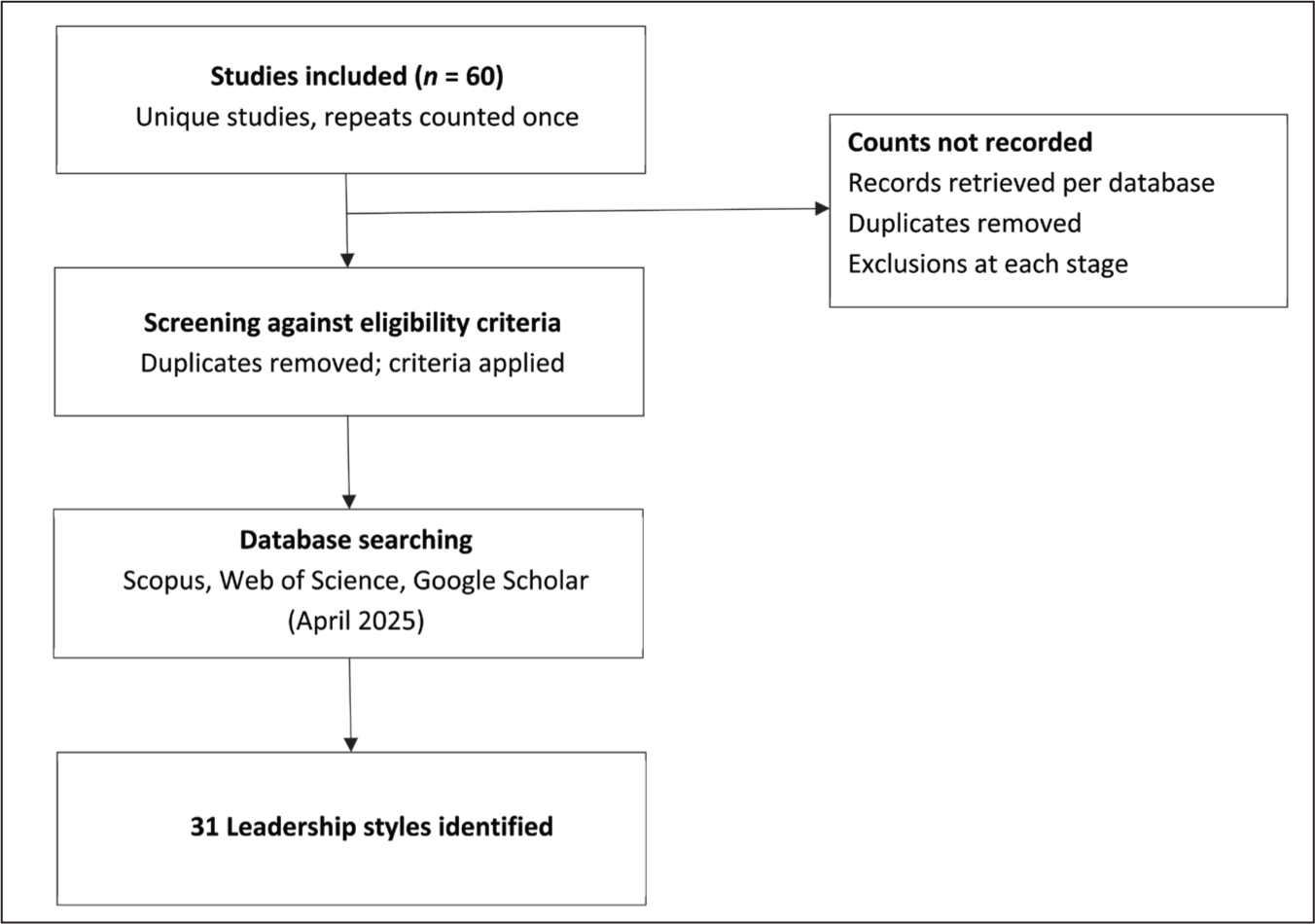
Review approach: A comprehensive review, rather than a systematic review, was selected as the aim was to explore the range of leadership styles that have been examined in start-up settings, rather than to combine effect sizes or to evaluate the quality of the studies (Grant & Booth, 2009; Snyder, 2019). A review protocol was not registered. To ensure a transparent and reproducible process, the searching, screening and selection stages were documented in a flow diagram inspired by the PRISMA 2020 statement (Page et al., 2021). This review is therefore labelled as PRISMA-adapted and is not considered to meet all criteria of the PRISMA checklist.
Databases and timeframe: A literature search was carried out on Scopus, Web of Science and Google Scholar in April 2025. The initial database search did not apply a lower chronological boundary because there might be some foundational research that was missed. The final synthesis retained relevant literature across a 27-year period, with publication ranging from 1998 to April 2025.
Search strings: The following string was used for titles, abstracts and keywords in Scopus (TITLE-ABS-KEY) and Web of Science (Topic):
Each of the four context terms was used separately with the term ‘leadership style’ in Google Scholar.
Eligibility criteria: Studies were included if they,
were peer-reviewed journal articles;
explicitly examined or discussed one or more leadership styles;
were set in start-ups, new ventures, entrepreneurial firms, or early-stage firms;
were published within the timeframe above; and
were available in full text.
Studies were excluded if they,
were not peer-reviewed (e.g., theses, working papers, editorials, or trade press);
concerned established or large organisations with no start-up or early-stage focus;
could not be retrieved in full text; or
were duplicate records.
Screening and selection: The searches were conducted in Scopus, Web of Science, and Google Scholar in April 2025, and the resulting records were screened according to the above eligibility criteria. Because this phase followed a comprehensive review without a registered protocol, the number of records retrieved from each database, the number of records excluded during each screening phase and the number of duplicates removed were not recorded at the time and therefore cannot be reported. Figure 1, therefore, shows the process and the verified result: 60 unique studies were screened, and studies that were cited under more than one leadership style were counted once, resulting in 31 distinct leadership styles in total. The search strings, databases, search month, time period and eligibility criteria are fully reported, and that there are no intermediate counts is acknowledged as a limitation.
Data extraction and coding: For each retained study, the leadership style(s) examined were recorded, yielding 31 distinct styles (Table 1).
| S. No. | Leadership Style | Key Citations |
| 1 | Transformational | |
| 2 | Transactional | |
| 3 | Laissez-faire | |
| 4 | Entrepreneurial | |
| 5 | Authentic | |
| 6 | Authoritative | |
| 7 | Democratic | |
| 8 | Facilitative | |
| 9 | Situational | |
| 10 | Self-Leadership | |
| 11 | Millennial Transformational | |
| 12 | Pacesetting | |
| 13 | Instrumental | |
| 14 | Executive | |
| 15 | Contingency | |
| 16 | Visionary | |
| 17 | Co-creative and Assertive Coaching | |
| 18 | Autocratic | |
| 19 | Humble | |
| 20 | Team (Collective) | |
| 21 | Empathetic | |
| 22 | Strategic | |
| 23 | Digital | |
| 24 | Servant | |
| 25 | Environmental | |
| 26 | Authentic-Servant | |
| 27 | Passive | |
| 28 | Emotional | |
| 29 | Empowerment | |
| 30 | Sports-Inspired | |
| 31 | Paternalistic |
Source: Compiled by author via review literature.
Phase 2: Delphi Study
Expert selection: The experts were identified using purposive sampling, where the selection of respondents is based on their knowledge of the phenomenon being studied (Etikan et al., 2016). Eligibility required at least 3 years of direct experience in founding, managing, staffing, advising or researching start-ups. Candidates were recruited nationwide through professional networks, LinkedIn, incubators, and entrepreneurship forums. Thirty experts were invited. All were told at invitation that the study involved multiple rounds aimed at reaching consensus, and only those willing to take part in the whole process were asked to proceed with Round 1. The final panel consisted of 20 of the 30 invited participants (66.7%), who agreed to both rounds. Delphi guidance does not specify what the size of the panel should be, as it varies with the homogeneity of the panel and the purpose of the study (Okoli & Pawlowski, 2004; Skulmoski et al., 2007).
Panel composition and demographic profile: The panel consisted of founders (3), co-founders (4), senior managers (6), HR professionals (4) and academicians or consultants specialising in leadership and entrepreneurship (3). This is a blend of those who create enterprises, those who manage people in the enterprise, and those who study and advise on leadership. The complete profile is provided in Table 2. Most experts were male (65%) and aged 25-44 years (60%). All held at least a graduate degree, with 70% holding a post-graduate or doctoral qualification. 50% had 6-8 years of work experience, and the panel covered five industries, with IT and services as the majority (30%).
| Characteristic | Category | n | % |
| Role | Founders | 3 | 15.0 |
| Co-founders | 4 | 20.0 | |
| Senior managers | 6 | 30.0 | |
| HR professionals | 4 | 20.0 | |
| Academicians/consultants | 3 | 15.0 | |
| Gender | Male | 13 | 65.0 |
| Female | 7 | 35.0 | |
| Age group | 24 years and below | 2 | 10.0 |
| 25–34 years | 5 | 25.0 | |
| 35–44 years | 7 | 35.0 | |
| 45–54 years | 4 | 20.0 | |
| 55 years and above | 2 | 10.0 | |
| Education | Graduate | 6 | 30.0 |
| Post-graduate | 10 | 50.0 | |
| Ph.D. | 4 | 20.0 | |
| Work experience | 3–5 years | 4 | 20.0 |
| 6–8 years | 10 | 50.0 | |
| 9 years and above | 6 | 30.0 | |
| Industry | IT and services | 6 | 30.0 |
| Healthcare and life sciences | 2 | 10.0 | |
| Agriculture and agri-tech | 4 | 20.0 | |
| Automotive and manufacturing | 5 | 25.0 | |
| EdTech | 3 | 15.0 |
Source: Primary Data.
Note: Academicians/consultants (n = 3) are classified by the sector they primarily research or advise.
Data collection: The data were gathered by means of an online questionnaire sent by email from October 2025 to November 2025. Panellists participated anonymously and did not know the identities of the other experts. In Round 1, experts rated each of the 31 leadership styles on a five-point scale (1 = Very Rare/Not Relevant/Not Confident to 5 = Very Common/Extremely Relevant/Very Confident) according to three criteria: prevalence (how commonly this style exists in start-ups); relevance (how relevant this style is to start-up contexts); and confidence (how certain they are about their evaluation). In Round 2, conducted 3 weeks after Round 1, each expert received the group means across all three criteria, together with a summary of the comments for every style from Round 1, and was invited to rerate it. Delphi studies usually are terminated when consensus or stability is reached, or when additional rounds contribute little (Hasson et al., 2000). A two-round Delphi process was deemed sufficient for this study, as the traditional initial brainstorming phase was superseded by a comprehensive literature review.
Non-response and scoring shifts: There was no participant attrition or missing data between the two rounds, as all 20 experts completed both rounds (retention = 100%). Non-response occurred only at recruitment, when 10 of the 30 invitees did not enrol. Shifts in scoring were assessed by counting the experts who revised each rating and comparing each style’s mean, interquartile range (IQR) and standard deviation (SD) across the two rounds. Round 2 ratings were considered the final judgement of each expert.
Data analysis: Excel was used to analyse the responses. The mean, median, SD, IQR and consensus level were calculated for each style, separately for prevalence, relevance, and confidence in both rounds. Consensus was ascertained across all three criteria, with each criterion classified separately for each style using thresholds defined a priori: high (SD <= 0.7 and IQR <= 1), moderate (SD <= 1.0 or IQR <= 1.5), and low (all other cases). These thresholds set a deliberately more stringent standard for high agreement than those typically reported in the literature (Diamond et al., 2014; von der Gracht, 2012). For each style, therefore, there were three consensus classifications, one for each criterion, and there were no overall classifications. Round 2 results are treated as the final judgements, and Round 1 results are shown for comparison. Styles were ranked by mean scores on prevalence, relevance and confidence to identify those most evident and most important in Indian start-ups.
Ethical Considerations
Participation was voluntary, and experts gave informed consent prior to Round 1. Responses were anonymous, and results are reported in aggregate so that no individual can be identified.
Methodological Limitations
Phase 1 was a comprehensive rather than a systematic review, so no protocol was registered and study quality was not appraised, and coverage is limited to the databases and terms used. In Phase 2, experts were purposively selected, and only those who were willing to participate in the entire process were enrolled (20 of 30 invited), which could cause self-selection bias. 65% of the panel was male, some industry- and role-based subgroups were quite small, and the consensus is the opinion of this panel and may not be generalisable to all stakeholders of Indian start-ups. Attrition bias is limited because retention was 100% throughout the rounds. Because the numbers of records retrieved, duplicates removed, and records excluded at each stage in Phase 1 were not recorded, that search cannot be replicated at the level of record counts, although the databases, search strings, search month, timeframe and eligibility criteria are fully reported.
Findings
The initial phase of this study involved a comprehensive literature review that identified 31 distinct leadership styles, which are operationalised with concise definitions in Table 3. These were subsequently evaluated through the Delphi method to determine their prevalence and relevance in Indian start-ups.
| S. No | Leadership Style | Definition |
| 1 | Transformational | Inspires employees through charisma, intellectual stimulation, and individualised consideration. |
| 2 | Transactional | Relies on contingent rewards and punishments to drive performance. |
| 3 | Laissez-faire | Leader ignores decision-making and takes a hands-off approach. |
| 4 | Entrepreneurial | Promotes innovation, risk-taking, and opportunity recognition to drive growth. |
| 5 | Authentic | Focuses on self-awareness, transparency, and ethical behaviour to build trust. |
| 6 | Authoritative | Provides clear direction and expects compliance, combining firmness with guidance. |
| 7 | Democratic | Engages the team members in the decision-making process and appreciates participatory input. |
| 8 | Facilitative | Emphasises enabling collaboration, dialogue, and shared problem-solving. |
| 9 | Situational | Changes leadership style based on the maturity and needs of followers. |
| 10 | Self-Leadership | People influence and motivate themselves by setting self-goals and regulating them. |
| 11 | Millennial Transformational | Contemporary adaptation of transformational leadership to millennial values (purpose, flexibility, digital integration). |
| 12 | Pacesetting | Establishes high-performance standards and expects quick results, often leading by example. |
| 13 | Instrumental | Focuses on task accomplishment, strategy execution, and structure. |
| 14 | Executive | Leadership that is undertaken at the highest levels with a focus on vision, governance and long-term planning. |
| 15 | Contingency | The effectiveness is based on the compatibility between the situational demands and the style of the leader. |
| 16 | Visionary | Develops and communicates an effective future vision that drives alignment. |
| 17 | Co-creative and Assertive Coaching | Provides direction to employees along with coaching them in a supportive manner as well as being assertive in leading the growth. |
| 18 | Autocratic | Leader makes unilateral decisions with minimal or little involvement of the subordinates. |
| 19 | Humble | Shows a sense of humility, feedback openness and recognises the contributions of others. |
| 20 | Team (Collective) | Leadership responsibilities are distributed within a group and not focused on a single person. |
| 21 | Empathetic | Values understanding and responding to the emotional needs of employees. |
| 22 | Strategic | Emphasises alignment of resources and decisions with long-term strategic goals. |
| 23 | Digital | Takes advantage of digital tools, platforms and innovation to transform processes and culture. |
| 24 | Servant | Values serving and empowering followers over self-interest. |
| 25 | Environmental | Incorporates eco-conscious values and environmental sustainability into leadership. |
| 26 | Authentic-Servant | Integrates servant leadership values with authenticity to build service and trust. |
| 27 | Passive | Avoids proactive engagement, often failing to resolve problems or provide direction. |
| 28 | Emotional | Utilises emotional intelligence to influence and manage the feelings of other people. |
| 29 | Empowerment | Delegates authority, fosters confidence, and promotes employee autonomy. |
| 30 | Sports-Inspired | Implements principles from sports (teamwork, discipline, resilience) in organisational leadership. |
| 31 | Paternalistic | Offers guidance and protection while anticipating loyalty and obedience in exchange. |
Source: The authors.
In accordance with the Delphi’s conventions, consensus of the participants was evaluated with two complementary dispersion measures, the IQR and SD (Diamond et al., 2014; Franc et al., 2023). The complete results of the first round of evaluations in Delphi are presented in Table 4.
| S. No | Leadership Style | Prevalence | Relevance | Confidence | ||||||||||||
| M | Median | SD | IQR | Con. | M | Median | SD | IQR | Con. | M | Median | SD | IQR | Con. | ||
| 1 | Transformational | 4.6 | 5 | 0.502 | 1 | High | 4.5 | 5 | 0.606 | 1 | High | 4.65 | 5 | 0.489 | 1 | High |
| 2 | Transactional | 4.5 | 4.5 | 0.512 | 1 | High | 4.45 | 4.5 | 0.604 | 1 | High | 4.5 | 4.5 | 0.512 | 1 | High |
| 3 | Laissez-faire | 4.05 | 4 | 0.759 | 1.25 | Mod. | 4.2 | 4 | 0.767 | 1 | Mod. | 4.1 | 4 | 0.788 | 1 | Mod. |
| 4 | Entrepreneurial | 4.6 | 5 | 0.502 | 1 | High | 4.55 | 5 | 0.510 | 1 | High | 4.5 | 4.5 | 0.512 | 1 | High |
| 5 | Authentic | 4.1 | 4 | 0.640 | 0.25 | High | 4.05 | 4 | 0.759 | 1.25 | Mod. | 4.25 | 4 | 0.638 | 1 | High |
| 6 | Authoritative | 2.4 | 2 | 0.502 | 1 | High | 2.35 | 2 | 0.587 | 1 | High | 2.45 | 2 | 0.510 | 1 | High |
| 7 | Democratic | 2.3 | 2 | 0.732 | 1 | Mod. | 2.8 | 3 | 0.767 | 1 | Mod. | 2.65 | 2.5 | 0.745 | 1 | Mod. |
| 8 | Facilitative | 2.05 | 2 | 0.686 | 0.25 | High | 2.1 | 2 | 0.640 | 0.25 | High | 2.15 | 2 | 0.670 | 1 | High |
| 9 | Situational | 2.9 | 3 | 0.852 | 1.25 | Mod. | 2.85 | 3 | 0.812 | 1.25 | Mod. | 3 | 3 | 0.725 | 0.5 | Mod. |
| 10 | Self-Leadership | 3.1 | 3 | 0.788 | 1.25 | Mod. | 2.75 | 2.5 | 0.850 | 1.25 | Mod. | 3.15 | 3 | 0.745 | 1 | Mod. |
| 11 | Millennial Transformational | 3.25 | 4 | 0.910 | 2 | Mod. | 3.3 | 3 | 0.801 | 1 | Mod. | 3.25 | 3 | 0.786 | 1 | Mod. |
| 12 | Pacesetting | 2.9 | 3 | 0.640 | 0.25 | High | 3.05 | 3 | 0.686 | 0.25 | High | 3 | 3 | 0.648 | 0 | High |
| 13 | Instrumental | 3 | 3 | 0.725 | 0.5 | Mod. | 2.9 | 3 | 0.718 | 1 | Mod. | 3.05 | 3 | 0.686 | 0.25 | High |
| 14 | Executive | 2.5 | 2 | 0.760 | 1 | Mod. | 3 | 3 | 0.858 | 1.25 | Mod. | 2.95 | 3 | 0.604 | 0 | High |
| 15 | Contingency | 3 | 3 | 0.725 | 0.5 | Mod. | 2.85 | 3 | 0.745 | 1 | Mod. | 3.15 | 3 | 0.745 | 1 | Mod. |
| 16 | Visionary | 3.1 | 3 | 0.718 | 1 | Mod. | 2.65 | 2 | 0.812 | 1 | Mod. | 2.75 | 3 | 0.716 | 1 | Mod. |
| 17 | Co-creative and Assertive Coaching | 2.5 | 2 | 0.760 | 1 | Mod. | 2.45 | 2 | 0.759 | 1 | Mod. | 3.15 | 3 | 0.745 | 1 | Mod. |
| 18 | Autocratic | 2.4 | 2 | 0.598 | 1 | High | 2.25 | 2 | 0.638 | 1 | High | 2.3 | 2 | 0.470 | 1 | High |
| 19 | Humble | 3.15 | 3 | 0.745 | 1 | Mod. | 2.7 | 3 | 0.656 | 1 | High | 2.8 | 3 | 0.615 | 1 | High |
| 20 | Team (Collective) | 3.2 | 3 | 0.767 | 1 | Mod. | 3 | 3 | 0.648 | 0 | High | 2.7 | 3 | 0.656 | 0 | High |
| 21 | Empathetic | 2.1 | 2 | 0.718 | 1 | Mod. | 2 | 2 | 0.725 | 0.5 | Mod. | 1.9 | 2 | 0.718 | 1 | Mod. |
| 22 | Strategic | 2 | 2 | 0.648 | 0 | High | 2.1 | 2 | 0.718 | 1 | Mod. | 2.05 | 2 | 0.686 | 0.25 | High |
| 23 | Digital | 3 | 3 | 0.648 | 0 | High | 2.35 | 2 | 0.812 | 1 | Mod. | 2.45 | 2 | 0.759 | 1 | Mod. |
| 24 | Servant | 2.25 | 2 | 0.850 | 1 | Mod. | 2.35 | 2 | 0.875 | 1 | Mod. | 3 | 3 | 0.725 | 0.5 | Mod. |
| 25 | Environmental | 2.4 | 2 | 0.882 | 1 | Mod. | 2.05 | 2 | 0.759 | 1.25 | Mod. | 2.25 | 2 | 0.910 | 1 | Mod. |
| 26 | Authentic-Servant | 3 | 3 | 0.858 | 1.25 | Mod. | 2.7 | 2 | 1.128 | 1 | Mod. | 2.6 | 2 | 1.095 | 1 | Mod. |
| 27 | Passive | 2.25 | 2 | 0.638 | 1 | High | 2.5 | 2.5 | 0.512 | 1 | High | 2.55 | 2.5 | 0.604 | 1 | High |
| 28 | Emotional | 2.55 | 2 | 0.998 | 2 | Mod. | 2.45 | 2 | 0.759 | 1 | Mod. | 2.7 | 2 | 0.864 | 1.25 | Mod. |
| 29 | Empowerment | 2.3 | 2 | 0.656 | 1 | High | 2.95 | 3 | 0.759 | 1.25 | Mod. | 3 | 3 | 0.794 | 2 | Mod. |
| 30 | Sports-Inspired | 3 | 3 | 0.917 | 1 | Mod. | 2.7 | 2.5 | 0.801 | 1 | Mod. | 2.85 | 3 | 0.875 | 1.25 | Mod. |
| 31 | Paternalistic | 2.55 | 2 | 0.998 | 2 | Mod. | 2.45 | 2 | 0.759 | 1 | Mod. | 2.4 | 2 | 0.882 | 1 | Mod. |
Source: Statistically Calculated data.
Note: M = Mean, SD = Standard Deviation, IQR = Interquartile Range, Con. Level = Consensus Level, Mod. = Moderate. Consensus: High = SD <= 0.70 and IQR <= 1.00; Moderate = SD <= 1.00 and IQR <= 1.50; Low = otherwise.
Interpretation of Round 1 ()
Prevalence (RQ2)
Consensus on prevalence was high for 12 of the 31 styles and moderate for 19. No style had low consensus. Five styles stood clearly apart from the rest: transformational and entrepreneurial leadership (both M = 4.6), transactional leadership (M = 4.5), authentic leadership (M = 4.1) and laissez-faire leadership (M = 4.05). Only one of the five, laissez-faire, had moderate consensus. The sixth-ranked style was millennial transformational leadership (M = 3.25, SD = 0.910, IQR = 2), which was 0.80 points lower than the fifth. The remaining 26 styles had means between 2 and 3.25, and 16 of the 31 styles had means below 3. The lowest-rated styles were strategic (M = 2), facilitative (M = 2.05) and empathetic leadership (M = 2.1). The majority of disagreement was found in emotional and paternalistic leadership (both SD = 0.998, IQR = 2) and for millennial transformational leadership.
Relevance (RQ3)
Consensus on relevance was high for 10 styles and moderate for 21, with none low. The same five styles were leading. Entrepreneurial leadership was rated as the highest (M = 4.55), followed by transformational (M = 4.5), transactional (M = 4.45), laissez-faire (M = 4.2), and authentic leadership (M = 4.05). Moderate consensus was observed for laissez-faire and authentic leadership. The sixth-ranked style, millennial transformational leadership (M = 3.3), was 0.75 points below the fifth. The means of 22 of the 31 styles were below 3; empathetic leadership had the lowest mean (M = 2).
Confidence
Experts’ confidence in their own ratings reached high consensus for 14 styles and moderate for 17. Confidence was the highest in transformational (M = 4.65), transactional (M = 4.5) and entrepreneurial leadership (M = 4.5).
Summary of Round 1
Round 1 identified the same set of 5 styles on both criteria. However, 8 of the 31 styles achieved high consensus across all 3 criteria, and 19 (prevalence) and 21 (relevance) styles were still at moderate consensus. A second round was then undertaken with the group means and summary of comments from Round 1 to determine if agreement would increase and if the ranking would remain. Table 5 presents the complete results of the second or final round of evaluations in Delphi.
| S. No | Leadership Style | Prevalence | Relevance | Confidence | ||||||||||||
| M | Median | SD | IQR | Con. | M | Median | SD | IQR | Con. | M | Median | SD | IQR | Con. | ||
| 1 | Transformational | 4.45 | 4 | 0.510 | 1 | High | 4.6 | 5 | 0.502 | 1 | High | 4.4 | 4 | 0.502 | 1 | High |
| 2 | Transactional | 4.35 | 4 | 0.489 | 1 | High | 4.45 | 4 | 0.510 | 1 | High | 4.45 | 4 | 0.510 | 1 | High |
| 3 | Laissez-faire | 4.45 | 4 | 0.510 | 1 | High | 4.4 | 4 | 0.502 | 1 | High | 4.35 | 4 | 0.489 | 1 | High |
| 4 | Entrepreneurial | 4.45 | 4 | 0.510 | 1 | High | 4.9 | 5 | 0.307 | 0 | High | 4.75 | 5 | 0.444 | 0.25 | High |
| 5 | Authentic | 4.45 | 4 | 0.510 | 1 | High | 4.25 | 4 | 0.550 | 1 | High | 4.4 | 4 | 0.502 | 1 | High |
| 6 | Authoritative | 2.9 | 3 | 0.640 | 0.25 | High | 2.9 | 3 | 0.640 | 0.25 | High | 2.85 | 3 | 0.587 | 0.25 | High |
| 7 | Democratic | 2.8 | 2.5 | 0.894 | 2 | Mod. | 3 | 3 | 0.858 | 1.25 | Mod. | 3 | 3 | 0.917 | 2 | Mod. |
| 8 | Facilitative | 2.85 | 3 | 0.670 | 1 | High | 2.9 | 3 | 0.640 | 0.25 | High | 2.95 | 3 | 0.686 | 0.25 | High |
| 9 | Situational | 3 | 3 | 0.973 | 2 | Mod. | 3 | 3 | 0.973 | 0.25 | Mod. | 3.15 | 3.5 | 0.933 | 2 | Mod. |
| 10 | Self-Leadership | 3.2 | 3 | 0.695 | 1 | High | 2.75 | 3 | 0.638 | 0.25 | High | 3.15 | 3 | 0.587 | 0.25 | High |
| 11 | Millennial Transformational | 3.3 | 3 | 0.656 | 1 | High | 3.8 | 4 | 0.695 | 0.25 | High | 3.65 | 4 | 0.587 | 1 | High |
| 12 | Pacesetting | 2.95 | 3 | 0.686 | 0.25 | High | 3.05 | 3 | 0.686 | 0.25 | High | 3.2 | 3 | 0.695 | 1 | High |
| 13 | Instrumental | 3.1 | 3 | 0.640 | 0.25 | High | 2.95 | 3 | 0.686 | 0.25 | High | 3.15 | 3 | 0.670 | 0.25 | High |
| 14 | Executive | 2.9 | 3 | 0.640 | 0.25 | High | 3.35 | 3 | 0.670 | 0.25 | High | 3 | 3 | 0.917 | 2 | Mod. |
| 15 | Contingency | 2.95 | 3 | 0.686 | 0.25 | High | 2.7 | 3 | 0.571 | 1 | High | 3 | 3 | 0.794 | 0.25 | Mod. |
| 16 | Visionary | 3.05 | 3 | 0.686 | 0.25 | High | 2.8 | 3 | 0.523 | 0.25 | High | 2.75 | 3 | 0.638 | 1 | High |
| 17 | Co-creative and Assertive Coaching | 2.95 | 3 | 0.686 | 0.25 | High | 2.95 | 3 | 0.686 | 0.25 | High | 3.2 | 3 | 0.695 | 0.25 | High |
| 18 | Autocratic | 2.95 | 3 | 0.686 | 0.25 | High | 2.7 | 3 | 0.656 | 1 | High | 2.95 | 3 | 0.686 | 0.25 | High |
| 19 | Humble | 3.2 | 3 | 0.695 | 1 | High | 2.75 | 3 | 0.638 | 0.25 | High | 2.85 | 3 | 0.670 | 1 | High |
| 20 | Team (Collective) | 3.15 | 3 | 0.670 | 0.25 | High | 3 | 3 | 0.973 | 0.25 | Mod. | 2.95 | 3 | 0.686 | 0.25 | High |
| 21 | Empathetic | 2.9 | 3 | 0.640 | 0.25 | High | 2.9 | 3 | 0.640 | 0.25 | High | 2.8 | 3 | 0.615 | 1 | High |
| 22 | Strategic | 2.75 | 3 | 0.638 | 1 | High | 2.8 | 3 | 0.695 | 1 | High | 2.7 | 3 | 0.571 | 0.25 | High |
| 23 | Digital | 3 | 3 | 0.973 | 1.25 | Mod. | 2.8 | 3 | 0.615 | 1 | High | 2.8 | 3 | 0.695 | 0.25 | High |
| 24 | Servant | 2.75 | 3 | 0.638 | 1 | High | 2.85 | 3 | 0.670 | 0.25 | High | 3.05 | 3 | 0.686 | 0.25 | High |
| 25 | Environmental | 2.45 | 2 | 0.686 | 1 | High | 2.15 | 2 | 0.670 | 1 | High | 2.7 | 3 | 0.470 | 1 | High |
| 26 | Authentic-Servant | 3 | 3 | 0.917 | 1 | Mod. | 2.85 | 3 | 0.587 | 0.25 | High | 2.65 | 3 | 0.587 | 1 | High |
| 27 | Passive | 2.45 | 2.5 | 0.604 | 1 | High | 2.8 | 3 | 0.695 | 1 | High | 2.7 | 3 | 0.656 | 1 | High |
| 28 | Emotional | 2.6 | 2.5 | 0.680 | 1 | High | 2.6 | 2.5 | 0.680 | 1 | High | 2.85 | 3 | 0.670 | 1 | High |
| 29 | Empowerment | 2.45 | 2 | 0.944 | 1 | Mod. | 3 | 3 | 0.973 | 2 | Mod. | 3 | 3 | 0.917 | 0.5 | Mod. |
| 30 | Sports-Inspired | 3.15 | 3 | 0.670 | 0.25 | High | 2.8 | 3 | 0.695 | 1 | High | 2.95 | 3 | 0.686 | 0.25 | High |
| 31 | Paternalistic | 2.65 | 3 | 0.670 | 0.25 | High | 2.65 | 3 | 0.587 | 1 | High | 2.6 | 2.5 | 0.680 | 1 | High |
Source: Statistically Calculated data.
Note: M = Mean, SD = Standard Deviation, IQR = Interquartile Range, Con. Level = Consensus Level, Mod. = Moderate. Consensus: High = SD <= 0.70 and IQR <= 1.00; Moderate = SD <= 1.00 and IQR <= 1.50; Low = otherwise.
Interpretation of Round 2 ()
Overall Consensus
In Round 2, consensus was high for 26 of the 31 styles on prevalence, 27 on relevance and 26 on confidence. None of the styles had low consensus on any criterion, and 23 styles had reached high consensus on all three criteria. The study’s consensus criterion was therefore met for most styles, including all of the highest-rated ones.
RQ2: The Five Most Prevalent Leadership Styles in Indian Start-ups
Four styles, transformational, entrepreneurial, authentic and laissez-faire leadership, were found to have the same statistics, M = 4.45, SD = 0.510, Median = 4, IQR = 1. They are therefore reported as joint first, because their order cannot be separated on these data. Transactional leadership was the fifth most common (M = 4.35, SD = 0.489). All five received high consensus, with each expert giving them a rating of 4 or 5. Millennial transformational leadership was the sixth-ranked style with M = 3.3. With a difference of 1.05, the five styles’ ranking is clear-cut. The other 26 styles had means between 2.45 and 3.3. Experts were also confident in their ratings of the five styles (M = 4.35 to 4.75, all with high consensus).
RQ3: The Five Most Relevant Leadership Styles for Indian Start-ups
Entrepreneurial leadership was the most strongly endorsed (M = 4.9, SD = 0.307, IQR = 0). It was followed by transformational (M = 4.6), transactional (M = 4.45), laissez-faire (M = 4.4) and authentic leadership (M = 4.25). Each of the five was rated as having high consensus. Millennial transformational leadership (M = 3.8, SD = 0.695, Median = 4, high consensus) was 0.45 points below the fifth-ranked style. This is a smaller gap than for prevalence and should be recognised when reporting the top five. Apart from this style, the other 25 styles had means between 2.15 and 3.35.
The same five styles occupied the top five for both prevalence and relevance in both rounds, and the order for relevance was identical in the two rounds.
Summary of the Final Round
In the final round, two sets of 5 styles emerged. For RQ2 (prevalence), the five most prevalent styles in Indian start-ups were transformational, entrepreneurial, authentic, laissez-faire and transactional leadership. For RQ3 (relevance), the five most relevant styles were entrepreneurial, transformational, transactional, laissez-faire and authentic leadership. The membership of both sets was identical across both rounds; they had reached high consensus by the final round and were clearly distinguished from the other 26 styles.
Discussion
The two-stage design of this study first mapped the sheer breadth of leadership styles that scholars have attached to the start-up context, and then used expert consensus to narrow that breadth down to a practically meaningful shortlist. Read together, the two stages tell a coherent story. The comprehensive review shows that start-up leadership research has borrowed liberally from adjacent fields, ranging from classical trait and behavioural theories (autocratic, democratic, laissez-faire), through the full-range leadership paradigm (transformational and transactional leadership), to more recent and context-specific constructs such as digital leadership, sports-inspired leadership, and authentic-servant leadership. The review categorises leadership styles into task-oriented, relations-oriented, and change-oriented (Derue et al., 2011; Yukl, 2012), as well as participative, passive, contingency, and context-bound. This proliferation is itself informative: it suggests that no single theoretical lens has yet achieved consensus as ‘the’ leadership theory of start-ups, and that founders in practice are likely to draw on several of these repertoires simultaneously rather than adhering to one textbook style.
The Delphi panel converged on entrepreneurial, transformational, transactional, laissez-faire and authentic leadership as the five leading styles on both criteria, relevance and prevalence, albeit in a different order of ranking for each. This is similar to and builds on a number of strands of literature that were reviewed.
Two observations follow. First, there is no predominant style in practice. Founders are seen as drawing on a broad repertoire of visionary, venture-oriented, values-based, autonomy-granting and contingent-reward behaviour (Cogliser & Brigham, 2004; Gupta et al., 2004). Second, the order of relevance indicates a change of focus. Transactional leadership is slightly lower in prevalence but is more relevant, suggesting that experts value structure and performance contingency somewhat more than is reflected in their practices. Authentic leadership shows the opposite tendency: it is as prevalent as the leading styles yet ranks last in relevance. Because every style in the portfolio is rated highly, this should be interpreted as a difference in priority, not as the presence or absence of a style. Values-based leadership is common, but experts see entrepreneurial and transformational behaviour as more critical for start-up success. Entrepreneurial leadership’s prominence aligns with its definitional proximity to the start-up phenomenon itself: because it fuses opportunity recognition, risk-taking, and vision-casting (Gupta et al., 2004; Renko et al., 2015), experts appear to treat it as almost inseparable from what it means to lead a new venture, a reading reinforced by its documented links to business-model innovation, tacit knowledge sharing, and lower employee turnover intention (Pu et al., 2022; Yang et al., 2019a, 2019b). Transformational leadership’s inclusion echoes findings from diverse start-up settings, from Zaech and Baldegger’s (2017) Swiss sample to Chammas and Hernandez’s (2019) Brazilian start-ups, where the style was repeatedly linked to firm performance, innovative behaviour, and employee creativity, even though a handful of studies (e.g., Prasad & Jahan, 2021, in Bangalore) found no significant link with revenue or patenting outcomes. The existence of transactional and laissez-faire leadership alongside these more ‘inspirational’ styles is noteworthy because it complicates any assumption that Indian start-ups are led purely through vision and charisma. Transactional leadership’s structured use of rewards and contingent monitoring appears well suited to the operational discipline that early-growth-stage ventures require once headcount expands (Baldegger & Gast, 2016; Madhyvadany & Panboli, 2023), while laissez-faire leadership’s association with founder autonomy-granting is consistent with evidence that its effects are highly context-dependent, helpful when paired with a clear formalisation system (Yeheskel & Lerner, 2005) but potentially harmful when guidance is genuinely absent (Skogstad et al., 2007). Their joint appearance in the panel’s ratings suggests that Indian start-up experts view leadership as a portfolio that shifts in emphasis as a venture matures, rather than a fixed trait of the founder. Finally, the emergence of authentic leadership reflects a theme recurring across the Indian-specific studies reviewed (Sengupta et al., 2021, 2023), where founders’ self-awareness, transparency, and ethical consistency were found to drive employee creativity and change readiness, an outcome plausibly amplified by a millennial-heavy start-up workforce that, per the literature, places a premium on leader authenticity.
The laissez-faire paradox. In the full-range model, laissez-faire is defined as non-leadership marked by avoidance and absence (Bass & Avolio, 1994) and is associated with role ambiguity, conflict and negative consequences (Judge & Piccolo, 2004; Skogstad et al., 2007). Here it is deemed ubiquitous alongside transformational and entrepreneurial leadership, and fourth in relevance, so it is not a marginal presence. We argue that panellists were more likely to rate intentional delegation than neglect, for three reasons:
Re-labelling. ‘Hands-off’ leadership in start-ups often means giving teams ownership of decisions, which resembles empowering leadership (Srivastava et al., 2006). Full-range measures do not distinguish this from abdication. In laissez-faire, employees have a high degree of autonomy and are only minimally guided, with effectiveness in outcomes depending on team capability, as noted in panel comments.
Substitutes for leadership. When team members are knowledgeable and self-directed, expertise and peer norms can take the place of directive leadership (Kerr & Jermier, 1978).
Situational fit. Low involvement can be appropriate for a team that is already experienced, but not for new hires or crisis situations.
The equal prevalence of laissez-faire and transformational leadership is consistent with the two co-occurring: a founder may set a compelling vision and then step back from execution. Since the panellists rated style labels and not observed behaviours, some of the ratings may reflect passive avoidance by overstretched founders. We thus differentiate between active-empowering and passive-avoidant laissez-faire.
Indian start-up context. Leadership is context-bound (Johns, 2006; Osborn et al., 2002), and four features of the Indian ecosystem help explain this portfolio:
Hierarchy vs. flat cultures. Indian workplaces have traditionally shown high power distance and paternalistic, nurturant-directive leadership (House et al., 2004; Sinha, 1980), while tech start-ups adopt flat, informal norms. Having both a transactional and an autonomy-granting style at the same time may reflect the need to serve employees with both expectations.
Generational shifts. Younger or first-generation founders and teams prefer mission-focused, collaborative leadership, which aligns with the high prevalence of transformational and authentic styles.
Investor pressure. A venture funding round in Bengaluru, Delhi NCR and Mumbai brings in milestone-based targets and burn rate scrutiny. This favours entrepreneurial leadership and supports the high relevance of transactional leadership.
Resource uncertainty. There is no one-size-fits-all style, as volatile funding and talent shortages together with the regulatory complexity require adaptability.
Combined, these five styles do not compete with each other but actually complement one another across the various aspects of start-up leadership: transformational and authentic leadership have to do with how the team is related and motivated, entrepreneurial leadership governs the strategic and opportunity-facing dimension, and transactional and laissez-faire leadership govern the operational dimension of how work actually gets structured and delegated. This pattern offers a more integrative reading of start-up leadership than any single style reviewed in isolation, and it is consistent with the broader observation in the literature that start-up leadership is not static but evolves across the venture’s life cycle (Baldegger & Gast, 2016; Dvalidze & Markopoulos, 2019; Zhao & Ren, 2022).
Implications
Theoretical Implications
This study contributes to the entrepreneurship and leadership literatures in the following ways. First, by systematically consolidating 31 leadership styles reported across the start-up literature into a single taxonomy, it provides scholars with a reference map of a field that has so far developed in scattered, single-style studies. Second, by empirically validating this taxonomy through a structured Delphi process rather than relying on a single research team’s judgement, the study offers a more defensible basis for future hypothesis-driven research on which styles merit closer quantitative investigation in the start-up context. Third, and specific to the Indian setting, the findings extend the largely Western- and East Asian-dominated start-up leadership literature (e.g., Zaech & Baldegger, 2017, in Switzerland; Kim & Zhao, 2024, in East Asia) by grounding the shortlist of prevalent styles in the perspectives of Indian founders, HR professionals, and academicians, thereby responding to the call in the literature for context-sensitive leadership research (Bala Subrahmanya, 2022). Fourth, five styles, spanning both ‘effective’ (transformational, transactional) and ‘ineffective’ (laissez-faire) categories of the full-range model, are all highly prevalent and relevant. This challenges the clean effective/ineffective split (Bass & Avolio, 1994; Judge & Piccolo, 2004) and supports configurational approaches. Fifth, distinguishing active-empowering from passive-avoidant forms links the full-range model to the empowering leadership literature (Srivastava et al., 2006) and suggests existing measures may conflate the two (Skogstad et al., 2007). Sixth, from the entrepreneurial leadership’s perspective, first rank of relevance, combined with top-tier prevalence, supports the consideration of this style as a distinct construct (Gupta et al., 2004; Renko et al., 2015) in mainstream typologies. Seventh, comparing a near-tied picture of practice with a differentiated picture of need offers a way to study leadership-context fit (Johns, 2006; Osborn et al., 2002). The modest gaps for transactional (slightly less prevalent, more relevant) and authentic (equally prevalent, least relevant) show how emphasis, not presence, differs. Eighth, constructs like authentic and transformational leadership are understood and valued differently, depending on power distance, generational change and investor pressure (Avolio & Gardner, 2005; Hofstede, 2001; House et al., 2004). Ninth, three testable propositions emerge as follows: P1: The performance effect of laissez-faire is positive when team expertise is high and negative when it is low. P2: Transactional leadership relates more strongly to outcomes in investor-backed than in bootstrapped start-ups. P3: Transformational and laissez-faire leadership co-occur in founders more often than the full-range model would predict.
Practical Implications
For founders and co-founders: The findings suggest that no single leadership style is sufficient on its own. Since all five styles are highly prevalent, the differentiator is knowing when to use each. Combine vision and opportunity orientation with clear targets; separate intentional empowerment (clear goals, defined decision rights, available support) from absence.
For investors and incubators: Programmes should reinforce transactional discipline, which experts rate as highly relevant, and test the founders’ ability to shift their styles as the firm scales.
For HR and leadership developers: Train leaders to know when to step back and when to step in, and do it with feedback systems that prevent passive-avoidant behaviour.
For multigenerational teams: The needs of the employees who come from a hierarchical background may be best addressed with explicit structure, whereas younger employees may prefer autonomy. Modify style mix according to the team composition and task maturity to minimise role ambiguity.
For policymakers and ecosystem bodies: Strengthen leadership capability building specific to the conditions in Bengaluru, Delhi NCR and Mumbai and scale up to emerging start-up cities.
Limitations and Directions for Future Research
This study is subject to several limitations that also point toward productive avenues for future research. First, the Delphi panel comprised 20 experts; while this is within the range considered acceptable for Delphi studies, a larger and more sector-diverse panel (spanning, for instance, fintech, deep-tech, and consumer-internet start-ups separately) could reveal whether the prevalence and relevance of these five styles vary by industry vertical. Second, the Delphi method is inherently a structured elicitation of expert opinion rather than a direct behavioural measurement; future research should triangulate these findings with quantitative, survey-based studies that measure leadership style and firm-level outcomes (such as growth, funding rounds secured, or employee turnover) directly within Indian start-ups. Third, the study is cross-sectional and does not capture how leadership style may shift as a venture moves from the ideation stage through early growth to scale-up, a progression that several of the reviewed studies (Baldegger & Gast, 2016; Zhao & Ren, 2022) suggest is significant; longitudinal designs would help clarify this trajectory. Finally, because the panel and the underlying literature are concentrated in a small number of start-up hubs (principally Bengaluru, Delhi NCR, and Mumbai), the generalisability of the findings to start-ups in smaller Tier-II and Tier-III ecosystems within India remains an open empirical question.
Conclusion
India’s start-up ecosystem has grown into one of the largest in the world, and leadership remains one of the most consistently cited determinants of whether a young venture survives its formative years. This study set out to bring order to a fragmented body of research on start-up leadership by comprehensively identifying the styles studied in the literature and then empirically determining, through a two-round Delphi study with 20 experts, which of these styles are most prevalent and relevant in the Indian context. Of the 31 styles identified through the comprehensive review, five, entrepreneurial, transformational, transactional, laissez-faire, and authentic leadership, emerged as the styles Indian start-up experts consider most characteristic of how founders and senior leaders actually lead. These styles appear to operate less as competing alternatives and more as complementary facets of a single leadership repertoire, one that balances vision and authenticity in building relationships with structure and autonomy in getting work done. The lesson to be learned for the founder of a start-up or venture in an uncertain period is that leadership is not about knowing and applying any one style, but when to know and apply each style.
The author extends sincere gratitude to the faculty and fellow researchers of the department for their invaluable guidance, constructive feedback, and steadfast academic support. Their expertise and generosity with time were instrumental to this research. The author also wishes to thank all those who, in various capacities, contributed to its successful completion.
The author declared no potential conflicts of interest with respect to the research, authorship and/or publication of this article.
The author received no financial support for the research, authorship and/or publication of this article.
Nisha Rani https://orcid.org/0000-0002-9376-5680
Abanumay R., Alalwani E., & Dukhaykh S. (2025). Unleashing employees’ entrepreneurial potential in Saudi start–up companies: The role of psychological empowerment as a mediator between entrepreneurial leadership and employees’ entrepreneurial behavior. BMC Psychology, 13(1), Article 358. https://doi.org/10.1186/s40359–025–02680–6
Ako–Nai B. D. S. (2020). Leadership in a post COVID–19 era. Leadership, 8(29).
Alikhani Z., & Shahriari M. (2022). How does servant leadership increase the competitiveness of startup teams? The mediating role of employees’ self–efficacy. International Journal of Innovation Management, 26(2), Article 2250021. https://doi.org/10.1142/S1363919622500219
Antonakis J., & House R. J. (2004). On instrumental leadership: Beyond transactions and transformations [Paper presentation]. UNL Gallup Leadership Institute Summit, Omaha, NE, United States. https://www.spbkbd.com/english/art_english/art_26_030211.pdf
Antonakis J., & House R. J. (2014). Instrumental leadership: Measurement and extension of transformational–transactional leadership theory. The Leadership Quarterly, 25(4), 746–771. https://doi.org/10.1016/j.leaqua.2014.04.005
Antonio T., Indrianto A. T. L., & Padmawidjaja L. (2022). In search of mediators of leadership behavior to team creativity in team start–ups. Frontiers in Psychology, 13, Article 951603. https://doi.org/10.3389/fpsyg.2022.951603
Antonio T., Murwani F. D., Bernarto I., & Sudibyo N. (2021). Fostering team innovation in tech start–ups: The role of team ambidexterity as mediator between servant leadership behaviour and team innovation. International Journal of Innovation Management, 25(8), Article 2150091. https://doi.org/10.1142/S1363919621500912
Ardichvili A., Cardozo R. N., & Gasparishvili A. (1998). Leadership styles and management practices of Russian entrepreneurs: Implications for transferability of Western HRD interventions. Human Resource Development Quarterly, 9(2), 145–155. https://doi.org/10.1002/hrdq.3920090206
Arnold J. A., Arad S., Rhoades J. A., & Drasgow F. (2000). The empowering leadership questionnaire: The construction and validation of a new scale for measuring leader behaviors. Journal of Organizational Behaviour, 21(3), 249–269.
Ashkanasy N. M., & Daus C. S. (2005). Rumors of the death of emotional intelligence in organizational behavior are vastly exaggerated. Journal of Organizational Behavior, 26(4), 441–452. https://doi.org/10.1002/job.320
Avolio B. J., & Bass B. M. (2004). Multifactor leadership questionnaire. Mind Garden.
Avolio B. J., & Gardner W. L. (2005). Authentic leadership development: Getting to the root of positive forms of leadership. The Leadership Quarterly, 16(3), 315–338. https://doi.org/10.1016/j.leaqua.2005.03.001
Avolio B. J., Kahai S., & Dodge G. E. (2000). E–leadership: Implications for theory, research, and practice. The Leadership Quarterly, 11(4), 615–668. https://doi.org/10.1016/S1048–9843(00)00062–X
Aycan Z. (2006). Paternalism: Towards conceptual refinement and operationalization. In Indigenous and cultural psychology: Understanding people in context (pp. 445–466). Springer. https://doi.org/10.1007/0–387–28662–4_20
Azmy A., & Priyono A. (2022). Leadership roles for improving employee productivity at digital start–up company. Jurnal Manajemen Bisnis, 13(1), 16–27. https://doi.org/10.18196/mb.v13i1.11250
Bala Subrahmanya M. H. (2022). Competitiveness of high–tech start–ups and entrepreneurial ecosystems: An overview. International Journal of Global Business and Competitiveness, 17(1), 1–10. https://doi.org/10.1177/2393957519892746
Baldegger U., & Gast J. (2016). On the emergence of leadership in new ventures. International Journal of Entrepreneurial Behavior & Research, 22(6), 933–957. https://doi.org/10.1108/IJEBR–11–2015–0242
Bamiatzi V., Jones S., Mitchelmore S., & Nikolopoulos K. (2015). The role of competencies in shaping the leadership style of female entrepreneurs: The case of North West of England, Yorkshire, and North Wales. Journal of Small Business Management, 53(3), 627–644. https://doi.org/10.1111/jsbm.12173
Bass B. M. (1985). Leadership and performance beyond expectations. Free Press.
Bass B. M. (1990). From transactional to transformational leadership: Learning to share the vision. Organizational Dynamics, 18(3), 19–31. https://doi.org/10.1016/0090–2616(90)90061–S
Bass B. M., & Avolio B. J. (Eds.). (1994). Improving organizational effectiveness through transformational leadership. Sage.
Bednár R., & Ljudvigová I. (2020). Belbin team roles in a start–up team. SHS Web of Conferences, 83, Article 01002. https://doi.org/10.1051/shsconf/20208301002
Bhagavatula S., Mudambi R., & Murmann J. P. (2019). Innovation and entrepreneurship in India: An overview. Management and Organization Review, 15(3), 467–493. https://doi.org/10.1017/mor.2019.52
Burns J. M. (1978). Leadership. Harper & Row.
Cahyadi A., Marwa T., Hágen I., Siraj M. N., Santati P., Poór J., & Szabó K. (2022). Leadership styles, high–involvement human resource management practices, and individual employee performance in small and medium enterprises in the digital era. Economies, 10(7), Article 162. https://doi.org/10.3390/economies10070162
Chammas C. B., & Hernandez J. M. D. C. (2019). Comparing transformational and instrumental leadership: The influence of different leadership styles on individual employee and financial performance in Brazilian startups. Innovation & Management Review, 16(2), 143–160. https://doi.org/10.1108/INMR–08–2018–0064
Chelladurai P., & Saleh S. D. (1980). Dimensions of leader behavior in sports: Development of a leadership scale. Journal of Sport and Exercise Psychology, 2(1), 34–45. https://doi.org/10.1123/jsp.2.1.34
Chen M. H. (2007). Entrepreneurial leadership and new ventures: Creativity in entrepreneurial teams. Creativity and Innovation Management, 16(3), 239–249. https://doi.org/10.1111/j.1467–8691.2007.00439.x
Choongo P., Chileshe M., Lesa C. N., Mwiya B., & Taylor T. K. (2023). The effect of leadership styles on the growth of fintech start–ups in Zambia. FinTech, 2(4), 698–717. https://doi.org/10.3390/fintech2040039
Cogliser C. C., & Brigham K. H. (2004). The intersection of leadership and entrepreneurship: Mutual lessons to be learned. The Leadership Quarterly, 15(6), 771–799. https://doi.org/10.1016/j.leaqua.2004.09.004
Conger J. A., & Kanungo R. N. (1988). The empowerment process: Integrating theory and practice. Academy of Management Review, 13(3), 471–482. https://doi.org/10.5465/amr.1988.4306983
Dalkey N., & Helmer O. (1963). An experimental application of the Delphi method to the use of experts. Management Science, 9(3), 458–467. https://doi.org/10.1287/mnsc.9.3.458
Demja Z. B., & al Shurif S. (2021). Management of modern style startups through leadership aspects in the digital age. Journal Dimensie Management and Public Sector, 2(1), 23–28. https://doi.org/10.48173/jdmps.v2i1.94
Derue D. S., Nahrgang J. D., Wellman N. E., & Humphrey S. E. (2011). Trait and behavioral theories of leadership: An integration and meta–analytic test of their relative validity. Personnel Psychology, 64(1), 7–52. https://doi.org/10.1111/j.1744–6570.2010.01201.x
Diamond I. R., Grant R. C., Feldman B. M., Pencharz P. B., Ling S. C., Moore A. M., & Wales P. W. (2014). Defining consensus: A systematic review recommends methodologic criteria for reporting of Delphi studies. Journal of Clinical Epidemiology, 67(4), 401–409. https://doi.org/10.1016/j.jclinepi.2013.12.002
Divya S. (2022). Impact of authentic–servant leadership on trust and employee burnout in STEM start–ups during exogenous shocks. In Proceedings of the International Conference on Industrial Engineering and Operations Management (pp. 1–10).
DPIIT. (2019). The Gazette of India: Extraordinary. https://www.startupindia.gov.in/
Du S., & Wang J. (2022). The employee relationship analysis on innovation behavior of new ventures under the organizational psychology and culture. Frontiers in Psychology, 13, Article 804316. https://doi.org/10.3389/fpsyg.2022.804316
Dvalidze N., & Markopoulos E. (2019). Understanding the nature of entrepreneurial leadership in the startups across the stages of the startup lifecycle. In International Conference on Applied Human Factors and Ergonomics (pp. 281–292). Springer. https://doi.org/10.1007/978–3–030–20154–8_26
Egri C. P., & Herman S. (2000). Leadership in the North American environmental sector: Values, leadership styles, and contexts of environmental leaders and their organizations. Academy of Management Journal, 43(4), 571–604. https://doi.org/10.5465/1556356
El Sawy O. A., Kræmmergaard P., Amsinck H., & Vinther A. L. (2020). How LEGO built the foundations and enterprise capabilities for digital leadership. In Strategic information management (pp. 174–201). Routledge.
Ellinger A. D., Ellinger A. E., & Keller S. B. (2003). Supervisory coaching behavior, employee satisfaction, and warehouse employee performance: A dyadic perspective in the distribution industry. Human Resource Development Quarterly, 14(4), 435–458. https://doi.org/10.1002/hrdq.1078
Ely K., Boyce L. A., Nelson J. K., Zaccaro S. J., Hernez–Broome G., & Whyman W. (2010). Evaluating leadership coaching: A review and integrated framework. The Leadership Quarterly, 21(4), 585–599. https://doi.org/10.1016/j.leaqua.2010.06.003
Etikan I., Musa S. A., & Alkassim R. S. (2016). Comparison of convenience sampling and purposive sampling. American Journal of Theoretical and Applied Statistics, 5(1), 1–4. https://doi.org/10.11648/j.ajtas.20160501.11
Farahdiba D., Mahirah N. M. S., & Maengkom P. A. N. (2022). Factors influencing creative employees: An integration of transformational leadership theory in the case of start–ups employees in Indonesia. Journal Theoretical and Applied Management, 15(3), 394–407. https://doi.org/10.20473/jmtt.v15i3.38680
Farh J. L., & Cheng B. S. (2000). A cultural analysis of paternalistic leadership in Chinese organizations. In Li J. T., Tsui A. S., & Weldon E. (Eds.), Management and organizations in the Chinese context (pp. 84–127). Palgrave Macmillan. https://doi.org/10.1057/9780230511590_5
Fiedler F. E. (1967). A theory of leadership effectiveness. McGraw–Hill.
Fletcher D., & Arnold R. (2011). A qualitative study of performance leadership and management in elite sport. Journal of Applied Sport Psychology, 23(2), 223–242. https://doi.org/10.1080/10413200.2011.559184
Franc J., Hung K., Pirisi A., & Weinstein E. (2023). Analysis of Delphi study seven–point linear scale data by parametric methods–use of the mean and standard deviation. Prehospital and Disaster Medicine, 38(S1), s30–s31. https://doi.org/10.1017/S1049023X23001188
Freeman D., & Siegfried R. L. Jr., (2015). Entrepreneurial leadership in the context of company start–up and growth. Journal of Leadership Studies, 8(4), 35–39. https://doi.org/10.1002/jls.21351
Gardner W. L., Cogliser C. C., Davis K. M., & Dickens M. P. (2011). Authentic leadership: A review of the literature and research agenda. The Leadership Quarterly, 22(6), 1120–1145. https://doi.org/10.1016/j.leaqua.2011.09.007
Gastil J. (1994). A definition and illustration of democratic leadership. Human Relations, 47(8), 953–975. https://doi.org/10.1177/001872679404700805
Gentry W. A., Weber T. J., & Sadri G. (2007, April). Empathy in the workplace: A tool for effective leadership [Paper presentation]. Annual Conference of the Society for Industrial and Organizational Psychology, New York, NY, United States.
Goleman D. (1995). Emotional intelligence: Why it can matter more than IQ. Bantam Books.
Goleman D. (2000). Leadership that gets results. Harvard Business Review, 78(2), 78–90.
Goleman D. (2017). Leadership that gets results. In Leadership perspectives (pp. 85–96). Routledge. https://doi.org/10.4324/9781315250601
Goleman D., Boyatzis R. E., McKee A., & Morey A. (2002). Primal leadership: Realizing the power of emotional intelligence. Harvard Business School Press.
Graeff C. L. (1997). Evolution of situational leadership theory: A critical review. The Leadership Quarterly, 8(2), 153–170. https://doi.org/10.1016/S1048–9843(97)90014–X
Grant M. J., & Booth A. (2009). A typology of reviews: An analysis of 14 review types and associated methodologies. Health Information & Libraries Journal, 26(2), 91–108. https://doi.org/10.1111/j.1471–1842.2009.00848.x
Greenleaf R. K. (1970). The servant as leader. The Robert K. Greenleaf Center.
Greenleaf R. K. (1977). Servant leadership: A journey into the nature of legitimate power and greatness. Paulist Press.
Gross R., & Cabanda E. (2019). An empirical examination of leadership styles’ impact on innovative behaviour and entrepreneurial orientation in Canadian firms: A cross–cultural perspective. International Journal of Society Systems Science, 11(3), 187–208. https://doi.org/10.1504/IJSSS.2019.101736
Gupta V., MacMillan I. C., & Surie G. (2004). Entrepreneurial leadership: Developing and measuring a cross–cultural construct. Journal of Business Venturing, 19(2), 241–260. https://doi.org/10.1016/S0883–9026(03)00040–5
Hambrick D. C., & Mason P. A. (1984). Upper echelons: The organization as a reflection of its top managers. Academy of Management Review, 9(2), 193–206. https://doi.org/10.5465/amr.1984.4277628
Hasson F., Keeney S., & McKenna H. (2000). Research guidelines for the Delphi survey technique. Journal of Advanced Nursing, 32(4), 1008–1015. https://doi.org/10.1046/j.1365–2648.2000.t01–1–01567.x
Hersey P., & Blanchard K. H. (1965). Management of organizational behavior: Utilizing human resources. Prentice–Hall.
Hersey P., & Blanchard K. H. (1969). Life cycle theory of leadership. Training & Development Journal, 23(5), 26–34.
Hinkin T. R., & Schriesheim C. A. (2008). An examination of ‘nonleadership’: From laissez–faire leadership to leader reward omission and punishment omission. Journal of Applied Psychology, 93(6), 1234–1248. https://doi.org/10.1037/a0012875
Hofstede G. (2001). Culture’s consequences: Comparing values, behaviors, institutions, and organizations across nations (2nd ed.). Sage.
House R. J. (1971). A path goal theory of leader effectiveness. Administrative Science Quarterly, 16(3), 321–339. https://doi.org/10.2307/2391905
House R. J. (1996). Path–goal theory of leadership: Lessons, legacy, and a reformulated theory. The Leadership Quarterly, 7(3), 323–352. https://doi.org/10.1016/S1048–9843(96)90024–7
House R. J., Hanges P. J., Javidan M., Dorfman P. W., & Gupta V. (Eds.). (2004). Culture, leadership, and organizations: The GLOBE study of 62 societies. Sage.
Hsu C. C., & Sandford B. A. (2007). The Delphi technique: Making sense of consensus. Practical Assessment, Research, and Evaluation, 12(1), Article 10. https://doi.org/10.7275/pdz9–th90
Humala I. A. (2015). Leadership toward creativity in virtual work in a start–up context. Journal of Workplace Learning, 27(6), 426–441. https://doi.org/10.1108/JWL–08–2014–0059
Inc42. (2016). The annual Indian start–up funding report 2016–Not that bad a …. https://inc42.com/datalab/the–annual–indian–startup–funding–report–2016/
Inc42. (2024). The state of Indian startup ecosystem report 2024. https://inc42.com/reports/the–state–of–indian–startup–ecosystem–report–2024/
Indrianto A. T. L., Antonio T., & Padmawidjaja L. (2022). The application of servant leadership in building creativity in tourism start–up team in Surabaya. International Journal of Economics, Business and Accounting Research, 6(4), 2156–2171. https://doi.org/10.29040/ijebar.v6i4.6964
Ireland R. D., & Hitt M. A. (1999). Achieving and maintaining strategic competitiveness in the 21st century: The role of strategic leadership. Academy of Management Perspectives, 13(1), 43–57. https://doi.org/10.5465/ame.1999.1567311
Jalote P., & Natarajan P. (2019). The growth and evolution of India’s software industry. Communications of the ACM, 62(11), 64–69. https://doi.org/10.1145/3347863
Johns G. (2006). The essential impact of context on organizational behavior. Academy of Management Review, 31(2), 386–408. https://doi.org/10.5465/amr.2006.20208687
Jones R. L., Harris R., & Miles A. (2009). Mentoring in sports coaching: A review of the literature. Physical Education and Sport Pedagogy, 14(3), 267–284. https://doi.org/10.1080/17408980801976569
Joshi D., & Achuthan S. (2018). Leadership in Indian high–tech start–ups: Lessons for the future. In Thakkar B. (Ed.), The future of leadership (pp. 39–91). Palgrave Macmillan. https://doi.org/10.1007/978–3–319–73870–3
Judge T. A., & Piccolo R. F. (2004). Transformational and transactional leadership: A meta–analytic test of their relative validity. Journal of Applied Psychology, 89(5), 755–768. https://doi.org/10.1037/0021–9010.89.5.755
Kane G. (2019). The technology fallacy: People are the real key to digital transformation. Research–Technology Management, 62(6), 44–49. https://doi.org/10.1080/08956308.2019.1661079
Kang J. H., Solomon G. T., & Choi D. Y. (2015). CEOs’ leadership styles and managers’ innovative behaviour: Investigation of intervening effects in an entrepreneurial context. Journal of Management Studies, 52(4), 531–554. https://doi.org/10.1111/joms.12125
Kankariya R., Jain P., & Jagwani P. (2021). An analysis of start–ups ecosystem in India. Shodhsamhita, 8(2[II]), 316–318. https://www.researchgate.net/publication/379809706_AN_ANALYSIS_OF_START–UPS_ECOSYSTEM_IN_INDIA
K.C., R., & Sharma B. (2023). Organizational leadership styles in startups in Nepal. European Journal of Theoretical and Applied Sciences, 1(6), 858–864. https://doi.org/10.59324/ejtas.2023.1(6).82
Kerr S., & Jermier J. M. (1978). Substitutes for leadership: Their meaning and measurement. Organizational Behavior and Human Performance, 22(3), 375–403. https://doi.org/10.1016/0030–5073(78)90023–5
Kim J., & Zhao K. (2024). Rediscovering paternalistic leadership: A powerful engine for startup. Asian Journal of Technology Innovation. Advance online publication. https://doi.org/10.1080/19761597.2024.2421976
Kouzes J. M., & Posner B. Z. (2006). The leadership challenge. John Wiley & Sons.
Lee K., Roh T., Kim J., Park S., & Bae Y. (2025). Unpacking sustainability in start–ups: A systematic review and research agenda. Discover Sustainability, 6(1), 1–24. https://doi.org/10.1007/s43621–025–01070–7
Lestari A., Rijal S., Prameswari Y., Tjahyanto T., & Budiman D. (2023). The effect of position promotion, training, leadership style on employee career development in one of the start up companies. West Science Business and Management, 1(3), 157–168. https://doi.org/10.58812/wsbm.v1i03.86
Lewin K., Lippitt R., & White R. K. (1939). Patterns of aggressive behavior in experimentally created ‘social climates’. The Journal of Social Psychology, 10(2), 269–299. https://doi.org/10.1080/00224545.1939.9713366
Madhyvadany M., & Panboli S. (2023). Moderation role of transactional leadership on employee engagement: Recent challenges in Indian start–up companies–SmartPLS analysis. Journal of Statistics & Management Systems, 26(2), 379–400. https://doi.org/10.47974/JSMS–1020
Manz C. C. (1986). Self–leadership: Toward an expanded theory of self–influence processes in organizations. Academy of Management Review, 11(3), 585–600. https://doi.org/10.5465/amr.1986.4306232
Manz C. C., & Sims H. P. Jr., (1986). Leading self–managed groups: A conceptual analysis of a paradox. Economic and Industrial Democracy, 7(2), 141–165. https://doi.org/10.1177/0143831X8672002
Mbakara M. B., & Sasaka P. S. (2017). Strategic management factors affecting the performance of technopreneurial start–ups in Nairobi County, Kenya. International Journal of Arts and Commerce, 6(3), 1–20.
McCarthy P. X., Gong X., Stephany F., Braesemann F., Rizoiu M. A., & Kern M. L. (2023). The science of startups: The impact of founder personalities on company success. arXiv. https://doi.org/10.1038/s41598–023–41980–y
Men L. R., Chen Z. F., & Ji Y. G. (2018). Walking the talk: An exploratory examination of executive leadership communication at startups in China. Journal of Public Relations Research, 30(1–2), 35–56. https://doi.org/10.1080/1062726X.2018.1455147
Morris J. A., Brotheridge C. M., & Urbanski J. C. (2005). Bringing humility to leadership: Antecedents and consequences of leader humility. Human Relations, 58(10), 1323–1350. https://doi.org/10.1177/0018726705059929
Muhtadi A. (2023). Analyzing the relationship between technology usage and work productivity. Eastasouth Proceeding of Nature, Science, and Technology, 1(1), 84–93. https://doi.org/10.58812/epnst.v1i01.36
Nanus B. (1992). Visionary leadership: Creating a compelling sense of direction for your organisation. Jossey–Bass.
NASSCOM. (2017). Incubators/accelerators driving growth of Indian start–up ecosystem. https://nasscom.in/system/files/publication/NASSCOM_Incubators_and_Accelerators_Report_2017_22052017.pdf
Neck C. P., & Manz C. C. (2007). Mastering self–leadership: Empowering yourself for personal excellence (4th ed.). Pearson/Prentice Hall.
Negoro M. C. W., & Wibowo A. (2021). Empathetic leadership, job satisfaction and intention to leave among millennials in a start–up industry: Needs’ satisfaction as a mediating variable. Journal of Indonesian Economy and Business, 36(2), 136–154.
Okoli C., & Pawlowski S. D. (2004). The Delphi method as a research tool: An example, design considerations and applications. Information & Management, 42(1), 15–29. https://doi.org/10.1016/j.im.2003.11.002
Ordu U. B. A. (2020). Entrepreneurial leadership in start–up businesses. Bulgarian Comparative Education Society, 197–204.
Osborn R. N., Hunt J. G., & Jauch L. R. (2002). Toward a contextual theory of leadership. The Leadership Quarterly, 13(6), 797–837. https://doi.org/10.1016/S1048–9843(02)00154–6
Owens B. P., & Hekman D. R. (2012). Modeling how to grow: An inductive examination of humble leader behaviors, contingencies, and outcomes. Academy of Management Journal, 55(4), 787–818. https://doi.org/10.5465/amj.2010.0441
Page M. J., McKenzie J. E., Bossuyt P. M., Boutron I., Hoffmann T. C., Mulrow C. D., … Moher D. (2021). The PRISMA 2020 statement: An updated guideline for reporting systematic reviews. BMJ, 372, Article n71. https://doi.org/10.1136/bmj.n71
Pal A. (2023). Synergizing performance: A correlative analysis of sports strategies in management thinking for enhanced corporate success for Indian start ups. International Journal for Innovative Research in Multidisciplinary Field, 9(10), 14–26.
Pearce C. L., & Conger J. A. (2002). Shared leadership: Reframing the hows and whys of leadership. Sage.
Pellegrini E. K., & Scandura T. A. (2008). Paternalistic leadership: A review and agenda for future research. Journal of Management, 34(3), 566–593. https://doi.org/10.1177/0149206308316063
Peterson S. J., Walumbwa F. O., Byron K., & Myrowitz J. (2009). CEO positive psychological traits, transformational leadership, and firm performance in high–technology start–up and established firms. Journal of Management, 35(2), 348–368. https://doi.org/10.1177/0149206307312512
Pham T. H. D., Le Q. H., & Ho H. (2025). The impact of leadership behaviors on startup’s entrepreneurship in Vietnamese Southern areas in the time of Covid–19. International Journal of Emerging Markets, 20(4), 1705–1727. https://doi.org/10.1108/IJOEM–08–2022–1314
Phangestu J., Kountur R., & Prameswari D. A. (2020). The moderating effect of entrepreneurial leadership and competitive advantage on the relationship between business model innovation and startup performance. Journal of Business and Retail Management Research, 14(3), 53–61. https://doi.org/10.24052/JBRMR/V14IS03/ART–06
Prasad L., & Jahan N. F. (2021a). A study to assess the impact of transformational leadership on the growth of revenues in start–up companies in Bangalore city. ACADEMICIA: An International Multidisciplinary Research Journal, 11(10), 2252–2260.
Prasad L., & Jahan N. F. (2021b). A study to determine the impact of transformational leadership on patents in start–up companies in Bangalore city. Asian Journal of Management and Commerce, 2(2), 92–96.
Pu B., Sang W., Yang J., Ji S., & Tang Z. (2022). The effect of entrepreneurial leadership on employees’ tacit knowledge sharing in start–ups: A moderated mediation model. Psychology Research and Behavior Management, 15, 137–149. https://doi.org/10.2147/PRBM.S347523
Puspita M., Yuniarsih T., & Wibowo L. A. (2022). The influence of transformational leadership and knowledge sharing on innovative work behavior of millennial employees in start–up companies. In Proceedings of the 6th Global Conference on Business, Management, and Entrepreneurship (GCBME 2021) (pp. 418–423). Atlantis Press.
Ren Q., Xu Y., Zhou R., & Liu J. (2020). Can CEO’s humble leadership behavior really improve enterprise performance and sustainability? A case study of Chinese start–up companies. Sustainability, 12(8), Article 3168. https://doi.org/10.3390/su12083168
Renko M., El Tarabishy A., Carsrud A. L., & Brännback M. (2015). Understanding and measuring entrepreneurial leadership style. Journal of Small Business Management, 53(1), 54–74. https://doi.org/10.1111/jsbm.12086
Rua O. L., & Carvalho A. R. (2023). Linking transformational leadership to start–ups creativity. Management and Administrative Professional Review, 14(7), 11650–11673. https://doi.org/10.7769/gesec.v14i7.2498
Sadler P. (2003). Leadership. Kogan Page.
Sarkar P., Rahman F., & Radhakrishna P. (2022). Leadership in different startups and sectors (Delhi NCR, Bengaluru, Hyderabad and Ranchi). In Embracing change in business, management & social sciences (pp. 33–38).
Schwarz R. M. (2002). The skilled facilitator: A comprehensive resource for consultants, facilitators, managers, trainers, and coaches. John Wiley & Sons.
Sengupta S., Bajaj B., Singh A., Sharma S., Patel P., & Prikshat V. (2023). Innovative work behavior driving Indian startups go global–the role of authentic leadership and readiness for change. Journal of Organizational Change Management, 36(1), 162–179. https://doi.org/10.1108/JOCM–05–2022–0156
Sengupta S., Sharma S., & Singh A. (2021). Authentic leadership fostering creativity in start–ups: Mediating role of work engagement and employee task proactivity. Business Perspectives and Research, 9(2), 235–251. https://doi.org/10.1177/2278533720964298
Setiawan R., Eliyana A., Suryani T., & Liaw D. (2020). Promoting employee creativity: The practices of transformational leadership, knowledge sharing, and task conflict behaviour on start–up business in Indonesia. Systematic Reviews in Pharmacy, 11(12), 1272–1282.
Singh A., Sengupta S., & Sharma S. (2018). Towards a better understanding of the relationship between authentic leadership and its positive outcomes: A theoretical framework. International Journal of Innovation and Technology Management, 15(2), Article 1850013. https://doi.org/10.1142/S021987701850013X
Sinha J. B. P. (1980). The nurturant–task leader: A model of the effective executive. Concept.
Skogstad A., Einarsen S., Torsheim T., Aasland M. S., & Hetland H. (2007). The destructiveness of laissez–faire leadership behavior. Journal of Occupational Health Psychology, 12(1), 80–92. https://doi.org/10.1037/1076–8998.12.1.80
Skulmoski G. J., Hartman F. T., & Krahn J. (2007). The Delphi method for graduate research. Journal of Information Technology Education: Research, 6(1), 1–21.
Snyder H. (2019). Literature review as a research methodology: An overview and guidelines. Journal of Business Research, 104, 333–339. https://doi.org/10.1016/j.jbusres.2019.07.039
Srivastava A., Bartol K. M., & Locke E. A. (2006). Empowering leadership in management teams: Effects on knowledge sharing, efficacy, and performance. Academy of Management Journal, 49(6), 1239–1251. https://doi.org/10.5465/amj.2006.23478718
Stanishev M. (2022). Environmental leadership in start–ups. Papers of BAS. Humanities and Social Sciences, 9(1), 95–103.
Tandon A., Gupta A., Goel P., & Singh V. K. (2020). Impact of digitization on entrepreneurial ecosystems: An Indian perspective. International Journal of Business and Globalisation, 25(2), 154–169. https://doi.org/10.1504/ijbg.2020.107887
van Dierendonck D. (2011). Servant leadership: A review and synthesis. Journal of Management, 37(4), 1228–1261. https://doi.org/10.1177/0149206310380462
Van Velsor E., McCauley C. D., & Ruderman M. N. (Eds.). (2010). The Center for Creative Leadership handbook of leadership development. John Wiley & Sons.
Vecchio R. P., Justin J. E., & Pearce C. L. (2010). Empowering leadership: An examination of mediating mechanisms within a hierarchical structure. The Leadership Quarterly, 21(3), 530–542. https://doi.org/10.1016/j.leaqua.2010.03.014
von der Gracht H. A. (2012). Consensus measurement in Delphi studies: Review and implications for future quality assurance. Technological Forecasting and Social Change, 79(8), 1525–1536. https://doi.org/10.1016/j.techfore.2012.04.013
Walumbwa F. O., Avolio B. J., Gardner W. L., Wernsing T. S., & Peterson S. J. (2008). Authentic leadership: Development and validation of a theory–based measure. Journal of Management, 34(1), 89–126. https://doi.org/10.1177/0149206307308913
Wanasida A. S., Bernarto I., Sudibjo N., & Pramono R. (2021). Millennial transformational leadership on organizational performance in Indonesia fishery startup. The Journal of Asian Finance, Economics and Business, 8(2), 555–562. https://doi.org/10.13106/jafeb.2021.vol8.no2.0555
Westley F., & Mintzberg H. (1989). Visionary leadership and strategic management. Strategic Management Journal, 10(S1), 17–32. https://doi.org/10.1002/smj.4250100704
Whitmore J. (2010). Coaching for performance: The principles and practice of coaching and leadership (5th ed.). Quercus.
Wikipedia. (2025). Startup India. In Wikipedia. https://en.wikipedia.org/wiki/Startup_India#cite_note–21
Xiong W., & Yang Y. (2024). How organizational improvisational, transformational leadership styles impact innovation performance of start–up companies in VUCA environments. In Proceedings of the 16th International Joint Conference on Knowledge Discovery, Knowledge Engineering and Knowledge, Management (IC3K 2024)–Volume 3: KMIS (pp. 295–304). SCITEPRESS.
Yang J., Guan Z., & Pu B. (2019). Mediating influences of entrepreneurial leadership on employee turnover intention in startups. Social Behavior and Personality: An International Journal, 47(6), 1–13. https://doi.org/10.2224/sbp.8117
Yang J., Pu B., & Guan Z. (2019a). Entrepreneurial leadership and turnover intention in startups: Mediating roles of employees’ job embeddedness, job satisfaction and affective commitment. Sustainability, 11(4), Article 1101. https://doi.org/10.3390/su11041101
Yang J., Pu B., & Guan Z. (2019b). Entrepreneurial leadership and turnover intention of employees: The role of affective commitment and person–job fit. International Journal of Environmental Research and Public Health, 16(13), Article 2380. https://doi.org/10.3390/ijerph16132380
Yeheskel O., & Lerner M. (2005). Flexible institutionalization: On the role of managerial variables in technology start–ups. In The emergence of entrepreneurial economics (pp. 165–187). Emerald Group Publishing. https://doi.org/10.1016/S0737–1071(05)09010–4
Yehezkel O., & Lerner M. (2009). Born to be wild? On managerial capabilities and business performance in technology start–ups. International Studies of Management & Organization, 39(3), 6–31. https://doi.org/10.2753/IMO0020–8825390301
Yukl G. (2012). Effective leadership behavior: What we know and what questions need more attention. Academy of Management Perspectives, 26(4), 66–85. https://doi.org/10.5465/amp.2012.0088
Zaech S., & Baldegger U. (2017). Leadership in start–ups. International Small Business Journal, 35(2), 157–177. https://doi.org/10.1177/0266242616676883
Zaleznik A. (1977). Managers and leaders: Are they different? Harvard Business Review, 55(3), 67–78.
Zhao A., & Ren Y. (2022). The efficacy of leadership on success of a startup. In Proceedings of the 2022 7th International Conference on Social Sciences and Economic, Development (ICSSED 2022) (pp. 302–310). Atlantis Press.
Zhao J. (2021). Exploring the direct and indirect effects of emotional leadership on entrepreneurial success of start–ups in the hospitality sector (I). Asia–Pacific Journal of Humanities and Social Sciences, 1(2), 1–19.
